Quick answers
- Does Wolf show error codes?
- Wolf cooking appliances signal problems mostly through behavior rather than a long list of numeric codes — a clicking burner that won't light, an oven that won't reach temperature, or a control that locks up. Note the exact symptom and the model on the rating plate; that tells us which control logic your unit uses.
- Why does my Wolf burner click but not light?
- A burner that sparks but won't catch is usually a dirty or wet igniter, a clogged burner port, or a cap that's seated wrong — not a gas-supply fault. Dry and clean the burner and reseat the cap. If it still won't light or keeps sparking, the igniter or spark module needs service.
- Why is my Wolf oven not heating to temperature?
- A Wolf oven that runs cold or uneven usually has a failed bake or broil element on dual-fuel and electric models, a drifted temperature sensor, or an igniter that no longer opens the gas valve on all-gas ovens. We test the element, sensor and igniter against spec before replacing anything.
- How do I reset a Wolf oven?
- First rule out Control Lock and Sabbath mode — on Wolf wall ovens those disable the panel on purpose and clear from the settings menu, not a breaker. If the display is truly frozen, power-cycle at the oven's breaker for a minute. A reset clears a control glitch but never a failed element, igniter or sensor.
Wolf signals faults by behavior, not a code list
Unlike some control platforms that throw a long string of numbered faults, Wolf ranges and ovens mostly tell you something’s wrong through behavior — a burner that clicks but won’t catch, an oven that won’t reach temperature, a display that freezes or goes dark. Because the specific indicators vary by series and control generation, the single most useful thing you can give a technician is the exact symptom plus the model and serial from the rating plate. That tells us which logic your unit runs and turns a vague “it’s not working” into a targeted diagnosis.
What do the most common Wolf faults mean?
Because Wolf signals by behavior, the symptom itself is the closest thing to an error code — and it maps cleanly to a likely cause and a fix:
| Symptom or behavior | Likely meaning | What we do |
|---|---|---|
| Burner clicks but won’t light | Dirty or wet igniter, clogged port, or misaligned cap | Dry and clean the burner, reseat the cap, test the igniter and spark module |
| Oven won’t reach temperature | Failed element (dual-fuel/electric) or igniter not opening the gas valve (all-gas) | Test element, sensor and igniter against spec, replace the failed part |
| Uneven baking | Weak element or a sensor reading heat wrong and cutting off early | Verify real temperature with a thermometer, test the sensor curve |
| Panel shows only a clock or lock icon | Control Lock, Sabbath mode, or a power blip resetting the clock | Clear the intentional state from the settings menu, confirm it’s not a fault |
| Display stays frozen, dim or blank after a breaker cycle | Failed display or control board | Test the board against your model before any swap |
- Burner clicks but won’t light — usually a dirty or wet igniter, a clogged port, or a misaligned burner cap. Dry and clean the burner and reseat the cap before assuming a part failed.
- Oven won’t reach temperature — a failed bake or broil element on dual-fuel and electric ovens, a drifted temperature sensor, or an igniter that no longer opens the gas valve on all-gas models.
- Uneven baking — most often a weak element or a sensor reading the wrong heat and cutting off early.
- Frozen or blank control panel — a control or power fault; power-cycle at the breaker first.
Control Lock and Sabbath mode aren’t faults
Before you read a dead-looking panel as a failure, rule out two intentional states. Control Lock disables the touch panel to stop accidental presses and is cleared from the settings menu, not the breaker. Sabbath mode holds the oven at a setpoint with the displays and tones suppressed, so a unit that seems unresponsive may simply be running as designed. Knowing your model also matters because behavior differs between dual-fuel ranges (electric oven, gas top), all-gas ranges (glow-bar oven igniter), and electric wall ovens — a “won’t heat” on one is an element, on another an igniter.
How do I tell a control glitch from a failed part?
A control display is a clue, not a verdict. Put an independent oven thermometer inside and run a bake cycle: if the real temperature lags far behind the setpoint, you’re looking at an element or igniter; if the oven shuts off early or swings wildly, suspect the sensor. Bring that observation to the call and the diagnosis is half done — and we confirm every suspect part against its real specification before replacing it with a genuine OEM part, never on a guess. When the oven simply runs cold, our Wolf oven not heating guide walks through testing the element, sensor and igniter, while a clicking top burner is covered on our Wolf range burner and igniter page.
Why Bay Area kitchens push Wolf controls harder
A pro range earns its keep in the open, hard-cooking estate kitchens common across the Tri-Valley, Peninsula and Silicon Valley, and the local environment leaves its mark. Inland summer heat of 90–100°F bakes the cabinetry around a range and stresses the control electronics packed behind the fascia, so heat-soaked boards and displays show up more on Danville, Blackhawk and Los Altos Hills units. Hard water across the region scales burner ports and shortens glow-bar igniter life, which is why a “burner won’t light” or “oven runs cold” so often traces back to mineral buildup rather than the board. Closer to the coast and the fog line, salt-laden air corrodes igniter leads and spark connections over the years. Many of these ranges sit in custom suites with fitted trim and hillside, gated or white-glove access, so we read the model from the rating plate, test each suspect component against spec, and arrive with the right OEM part to finish the repair in one clean trip. For the full range of work we handle on these units see our Wolf range and oven repair overview, and the flat $89 diagnostic plus typical part bands are laid out on our Wolf repair cost page so there are no surprises before we arrive.
When it really is the board
Telling a heat-soaked control from a harmless lockup
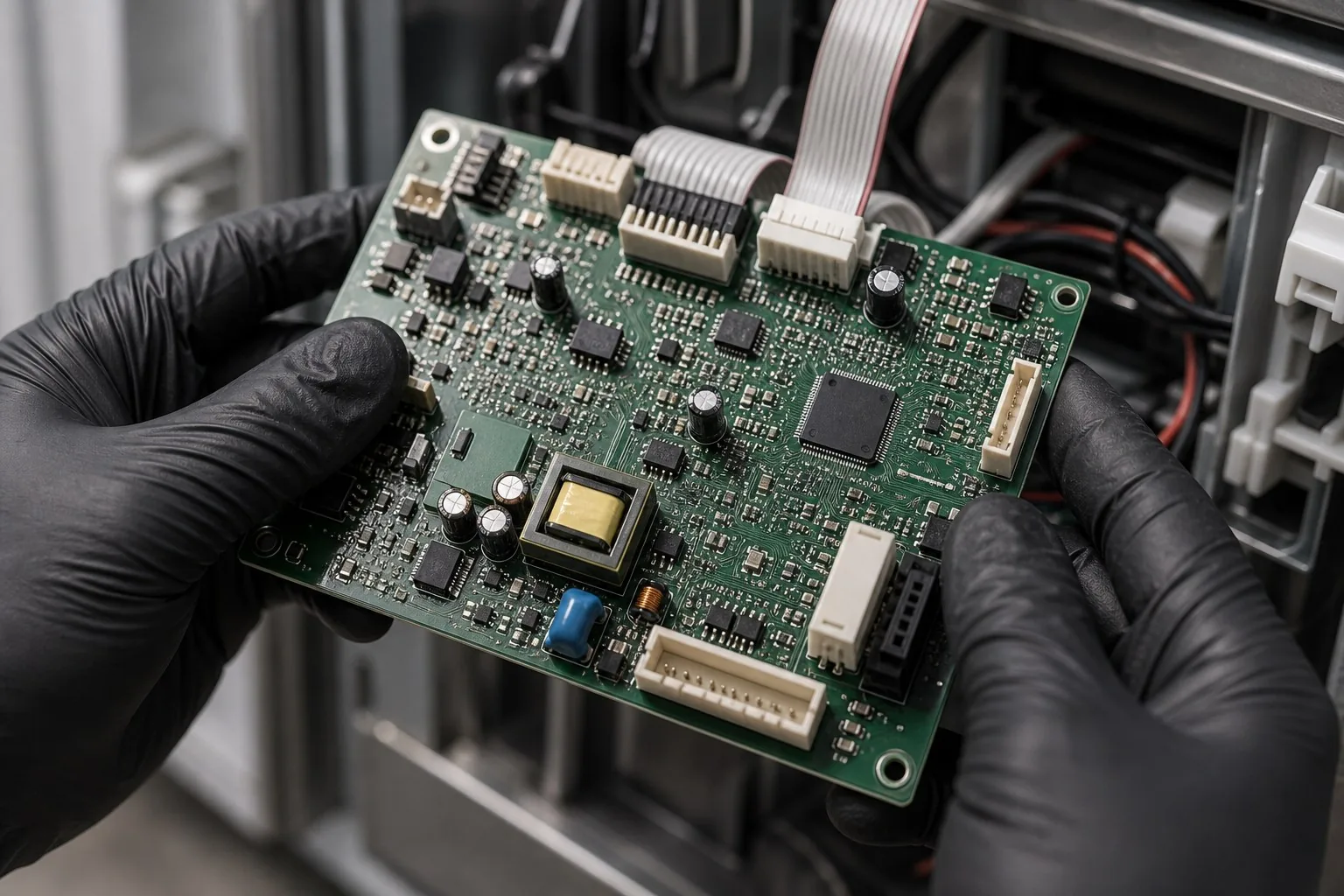
A panel showing only a clock or a lock icon is usually Control Lock or a power blip, not a failure. A display that stays dim, frozen or blank after a one-minute breaker cycle is the real signal — that points at the display or control board, which we test against your specific model rather than swapping on a hunch.
Before you call it a Wolf control fault
- Clear Control Lock from the settings menu — it disables the panel on purpose
- Confirm Sabbath mode is off; it suppresses displays and tones by design
- Power-cycle at the oven's breaker for a full minute, then re-check the panel
- Note dual-fuel vs. all-gas — a 'won't heat' is an element on one, an igniter on the other
- Drop an independent thermometer inside and run a bake to see real vs. set temperature
- Read the model and serial from the rating plate before describing the symptom
Frequently asked questions
Does Wolf show error codes?
Wolf cooking appliances signal problems mostly through behavior rather than a long list of numeric codes — a clicking burner that won't light, an oven that won't reach temperature, or a control that locks up. Note the exact symptom and the model on the rating plate; that tells us which control logic your unit uses.
Why does my Wolf burner click but not light?
A burner that sparks but won't catch is usually a dirty or wet igniter, a clogged burner port, or a cap that's seated wrong — not a gas-supply fault. Dry and clean the burner and reseat the cap. If it still won't light or keeps sparking, the igniter or spark module needs service.
Why is my Wolf oven not heating to temperature?
A Wolf oven that runs cold or uneven usually has a failed bake or broil element on dual-fuel and electric models, a drifted temperature sensor, or an igniter that no longer opens the gas valve on all-gas ovens. We test the element, sensor and igniter against spec before replacing anything.
How do I reset a Wolf oven?
First rule out Control Lock and Sabbath mode — on Wolf wall ovens those disable the panel on purpose and clear from the settings menu, not a breaker. If the display is truly frozen, power-cycle at the oven's breaker for a minute. A reset clears a control glitch but never a failed element, igniter or sensor.
What does a flashing or blank Wolf control panel mean?
First rule out the harmless causes — a panel showing only the clock or a lock icon is often Control Lock or a power interruption resetting the clock, not a fault. A truly frozen, dim or blank display after a breaker cycle points to a failed display or control board, which we test on site against your model.
What clients say
5 · 1705 reviews
Our Wolf wall oven panel went blank and I assumed a dead control board. The tech first ruled out Control Lock and Sabbath mode, then power-cycled at the breaker. The display came right back; it had been a lock icon all along. He charged only the diagnostic and saved me a board swap.
Wolf dual-fuel oven wouldn't reach temperature. He had me drop a thermometer inside and run a bake so we saw the real lag, then tested the bake element and sensor against spec. The element had failed. OEM part installed, even baking restored. Smart, no-guess approach.
An all-gas Wolf burner clicked but wouldn't catch, while the neighbors lit fine. The technician knew that meant a local fault, not the shared module, and traced it to a wet igniter and mineral-scaled port from our hard water. Cleaned and dried it, replaced the igniter. Quick and honest.