
Quick answers
- What does F2 mean on a GE Monogram oven?
- F2 is an over-temperature fault — the control sensed the oven got hotter than a safe limit during bake or self-clean. Power-cycle at the breaker first. If F2 returns, it usually points to the oven temperature sensor or a sticking control relay and should be diagnosed before you use the oven again.
- What does F3 or F4 mean on a GE Monogram oven?
- F3 and F4 indicate an oven temperature sensor (RTD) fault — F3 typically an open circuit, F4 typically a short. The fix is rarely guesswork: the sensor's resistance and its wiring and connector are tested against spec, because a bad connection can mimic a bad sensor.
- How do I reset a GE Monogram oven?
- Switch off the oven's circuit breaker for about a minute, then restore power. That clears many transient F codes and frozen displays. If the same code returns after the reset, it's a real component fault — note the code and the model number and book a diagnostic rather than clearing it repeatedly.
- Why is my GE Monogram oven stuck on F7 after cleaning the touchpad?
- F7 is a stuck-key fault, and aggressive wiping can momentarily short a membrane key — but it also appears when the touchpad ribbon or the control board fails. Power-cycle once at the breaker. If F7 returns, the touchpad or control is the suspect and the panel needs bench-level testing, not repeated clearing.
What do GE Monogram error codes mean?
GE Monogram ovens use GE’s long-standing “F” fault-code family, shown on the display with a tone, and each letter-and-number names a category of fault rather than a single broken part. The most common are F2 (over-temperature), F3 / F4 (the oven temperature sensor open or shorted), F7 (a stuck or shorted touch key), and door-lock faults that often surface after a self-clean cycle. The code tells you the category; the exact behavior and the model from the rating plate let a technician confirm which board and sensor your unit uses. Refrigeration faults on Monogram built-ins usually present as temperature drift or a stalled fan rather than a display code, so a cooling complaint goes through the same measurement-based path our GE Monogram refrigerator not cooling guide walks through, not a code on the panel.
Before you call
- Power-cycle once. Switch off the oven’s breaker for about a minute and restore power — many transient F codes and frozen displays clear here.
- Let a self-clean oven cool fully. The latch stays locked while hot by design; if it won’t release once cool, the latch motor or switch is the suspect.
- Write down the exact code and the model number before calling — that turns a guess into a targeted diagnosis.
Is an F3 or F4 code always a bad sensor?
No — F3 and F4 point at the oven temperature sensor, but a corroded connector or chafed harness can read exactly like a failed sensor. That’s why we test resistance against spec and inspect the wiring before condemning the part — replacing a good sensor wouldn’t fix the fault. The same discipline applies to F2: an over-temperature reading can come from the sensor or a relay sticking closed, and the two are diagnosed, not guessed. Every suspect part is confirmed on site before anything is replaced, and we install genuine OEM parts matched to the model on the rating plate.
What does it cost to clear a GE Monogram fault code?
The flat $89 diagnostic confirms which component is actually behind the code, and it’s waived when you approve the repair. A sensor (RTD), touchpad, or latch swap is a non-sealed repair in the $200–$700 band; only sealed-system refrigeration work on a Monogram built-in reaches the $900–$2,000 range. A code that returns minutes after a breaker reset is a real fault worth fixing promptly, since clearing it repeatedly lets a marginal control degrade further. For full price context see our GE Monogram repair cost guide, and our GE Monogram repair hub covers how a whole-appliance diagnostic is run.
Why Bay Area kitchens see these codes
Monogram ranges and wall ovens anchor a lot of Peninsula and Tri-Valley estate kitchens, and the local environment shapes which faults turn up. Self-clean is the most common trigger for F2 and door-lock codes here — homeowners run a long pyrolytic cycle before a dinner party, and the extreme heat is exactly when a marginal sensor, relay, or latch fails. Inland heat from Danville to Pleasanton, with summer kitchens running 90–100°F, adds load that pushes an aging control over the edge. Near the coast and the bay, salt-laden fog corrodes sensor connectors and ribbon contacts, which is a frequent root cause behind intermittent F3, F4, and F7 codes that “come and go.” On gated and hillside properties we plan the visit around access so the diagnosis happens in one trip, with the model number read on arrival and the fault confirmed by measurement before any part is ordered.
What to capture before you book
- The exact code as shown — F2 versus F3 reads differently to a technician
- Whether it appeared during bake, broil, or a self-clean cycle
- If it cleared after a breaker reset, or returned within minutes
- The model and serial from the rating plate (frame behind the door)
- Any error tone pattern, and whether the door will open
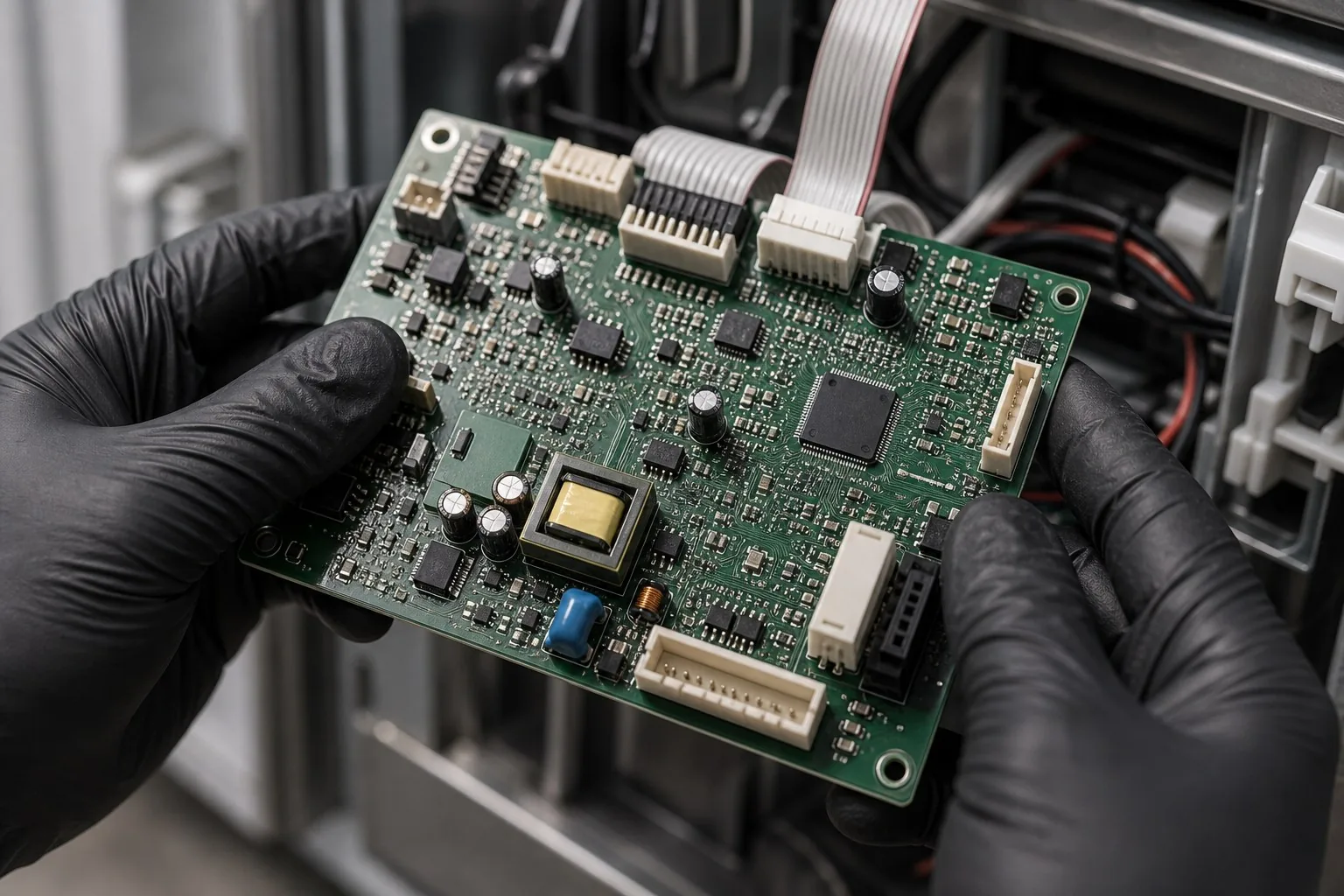
Error codes & what they mean
| Code / alarm | What it means | What to do |
|---|---|---|
F2 | Oven over-temperature — the control sensed the oven exceeded a safe temperature during bake or self-clean. | Power-cycle at the breaker. If F2 returns, it commonly points to the oven temperature sensor or control relay sticking — have it diagnosed before using the oven again. |
F3 / F4 | Oven temperature sensor (RTD) fault — F3 typically an open sensor circuit, F4 typically a shorted one. | Note the code and book a diagnostic; the sensor and its wiring/connector are tested against resistance spec before the sensor is replaced. |
F7 | Stuck or shorted touch key / membrane on the control panel. | Power-cycle at the breaker. If F7 persists, the touchpad or control needs service — a stuck key keeps the control from responding correctly. |
Door lock / latch fault | Door-latch or lock-circuit fault — often after a self-clean cycle when the latch fails to lock or release. | Let the oven cool fully (the latch stays locked while hot). If the door won't release once cool or the lock error persists, the latch motor or switch needs service. |
Frequently asked questions
What does F2 mean on a GE Monogram oven?
F2 is an over-temperature fault — the control sensed the oven got hotter than a safe limit during bake or self-clean. Power-cycle at the breaker first. If F2 returns, it usually points to the oven temperature sensor or a sticking control relay and should be diagnosed before you use the oven again.
What does F3 or F4 mean on a GE Monogram oven?
F3 and F4 indicate an oven temperature sensor (RTD) fault — F3 typically an open circuit, F4 typically a short. The fix is rarely guesswork: the sensor's resistance and its wiring and connector are tested against spec, because a bad connection can mimic a bad sensor.
How do I reset a GE Monogram oven?
Switch off the oven's circuit breaker for about a minute, then restore power. That clears many transient F codes and frozen displays. If the same code returns after the reset, it's a real component fault — note the code and the model number and book a diagnostic rather than clearing it repeatedly.
Why is my GE Monogram oven stuck on F7 after cleaning the touchpad?
F7 is a stuck-key fault, and aggressive wiping can momentarily short a membrane key — but it also appears when the touchpad ribbon or the control board fails. Power-cycle once at the breaker. If F7 returns, the touchpad or control is the suspect and the panel needs bench-level testing, not repeated clearing.
Should I keep clearing a GE Monogram error code?
No. Power-cycle once to rule out a glitch, but a code that keeps returning is a real fault — clearing it just masks the problem and can let it get worse. Note the exact code and the model from the rating plate and have it diagnosed before the next use.
What clients say
4.9 · 327 reviews
Our Monogram wall oven threw an F3 the morning of a self-clean. The tech didn't just swap the sensor — he measured its resistance, found a corroded RTD connector instead, and reseated it. Code gone, sensor saved. Honest diagnosis on a GE Monogram error code beats a guessed part.
F2 over-temperature kept locking us out after the breaker reset. He traced it to a bake relay sticking closed on the control, not the sensor, and replaced the board with a genuine part. Walked me through why the code came back and quoted it in writing first.
After wiping the touchpad our Monogram range stuck on F7. The tech confirmed it was a failed control ribbon, not a momentary short, and installed the OEM panel. He explained F7 is a stuck-key fault and not to keep clearing it. One trip, fixed correctly.