
Quick answers
- How long do high-end refrigerators last?
- A well-maintained luxury built-in typically lasts 25–30 years — far longer than a mass-market fridge. Regular condenser cleaning and timely repairs are what reach the top of that range, which is why repair usually beats replacement on these units.
- When is it not worth repairing?
- Replace when multiple major components fail together — say a compressor and a control board and a leaking sealed system — or when a single repair would exceed roughly half the installed price of a new comparable unit. One major fault alone rarely justifies replacement.
- Why does custom cabinetry change the decision?
- A built-in is fitted to custom panels, trim and a precise cabinet opening. Replacing it can mean re-sizing the surround, new panels and reinstallation — costs a like-for-like price comparison hides. Keeping a repairable unit preserves that fitted kitchen.
- Is a compressor failure a reason to replace?
- Not by itself. On Sub-Zero the sealed system — compressor, condenser, evaporator, drier and tubing — carries a 12-year manufacturer warranty, so a compressor fault may cost far less than the sticker suggests. Verify warranty coverage before deciding.
How long do high-end refrigerators actually last?
A maintained luxury built-in lasts 25–30 years, versus about a decade for a mass-market fridge, and that single gap is what flips the math toward repair. Once a disposable fridge is out of warranty the replace-it instinct is often right. A high-end built-in is a different machine — you are extending a long-lived, expensive unit, not propping up a throwaway one — so the same repair bill that would total a cheap fridge is a sound investment in a built-in with a decade or more of service left. Regular condenser cleaning, covered in our maintenance guide, is what actually reaches the top of that 25–30 year range.
Repair or replace? A quick decision table
| Situation | Lean toward | Why |
|---|---|---|
| One major fault, repair under ~50% of installed price | Repair | Below the 50% line repair is almost always the better value |
| Sealed-system / compressor fault on a unit under 12 years | Repair | Sub-Zero’s 12-year sealed-system warranty can absorb the line item |
| Multiple majors at once (compressor + board + leak) | Replace | Stacked failures cross the 50% line one alone would not |
| Obsolete, genuinely unavailable parts | Replace | Rare on these brands, but a real reason on very old models |
| Custom cabinetry, panels and stone surround fitted | Repair | Replacement adds remade panels and a fabricator a calculator hides |
What is the 50% rule for appliance repair?
The 50% rule says replace only when a single repair would cost more than about half the installed price of a new comparable unit; below that line, repair is almost always the better value — especially early in the unit’s life. Note “installed price,” not the shelf price: a built-in’s true replacement cost includes panels, trim and fitting. To weigh a real quote against that line, our repair cost ranges show where common faults land — most non-sealed work runs $200–$700, while sealed-system or compressor jobs run $900–$2,000.
When replacement actually wins
- Multiple major failures at once — e.g. a failed compressor and a dead control board and a leaking sealed system. Stacked majors can cross the 50% line where one alone would not.
- Obsolete, unavailable parts — rare on these brands, but it happens on very old or discontinued models.
- A repair that wouldn’t last — if the underlying cause (corrosion, prior poor work) means the fix is a stopgap, we’ll say so.
A single sealed-system fault, on its own, almost never reaches that bar — the sealed-system warranty on a Sub-Zero runs 12 years and frequently covers the compressor, condenser, evaporator, drier and tubing that would otherwise be the most expensive line on the quote.
The cost custom cabinetry hides
A freestanding fridge is swapped in an afternoon. A built-in is fitted to a precise opening with custom door panels and trim, often flanked by stone and millwork. Replacing it can mean new panels, a re-sized surround and careful reinstallation — real money a like-for-like price tag never shows.
Why replacement runs higher in Bay Area estate kitchens
On the Peninsula and in Tri-Valley estate kitchens, the swap is rarely a swap. Many of these units sit in remodeled rooms where the refrigerator opening was framed to a discontinued model’s exact dimensions, wrapped in book-matched stone and fitted millwork. A new unit often means a different footprint, custom panels remade to match adjacent cabinetry, and a stone fabricator back on site — frequently more than the appliance itself. Add hillside and gated-community access, where oversized built-ins need extra crew and protected pathways to move in, and the installed figure climbs well past the showroom sticker. Against that, a clean sealed-system or board repair on a 12-year-old Sub-Zero is usually the obvious call.
We diagnose first, quote in writing, and tell you honestly which side of the line your unit is on before you spend anything. That candid math — not a sales pitch — is how a well-kept built-in reaches the far end of its 25–30 year life. If you are still weighing the call, our appliance repair answers page covers the adjacent questions owners ask before booking.
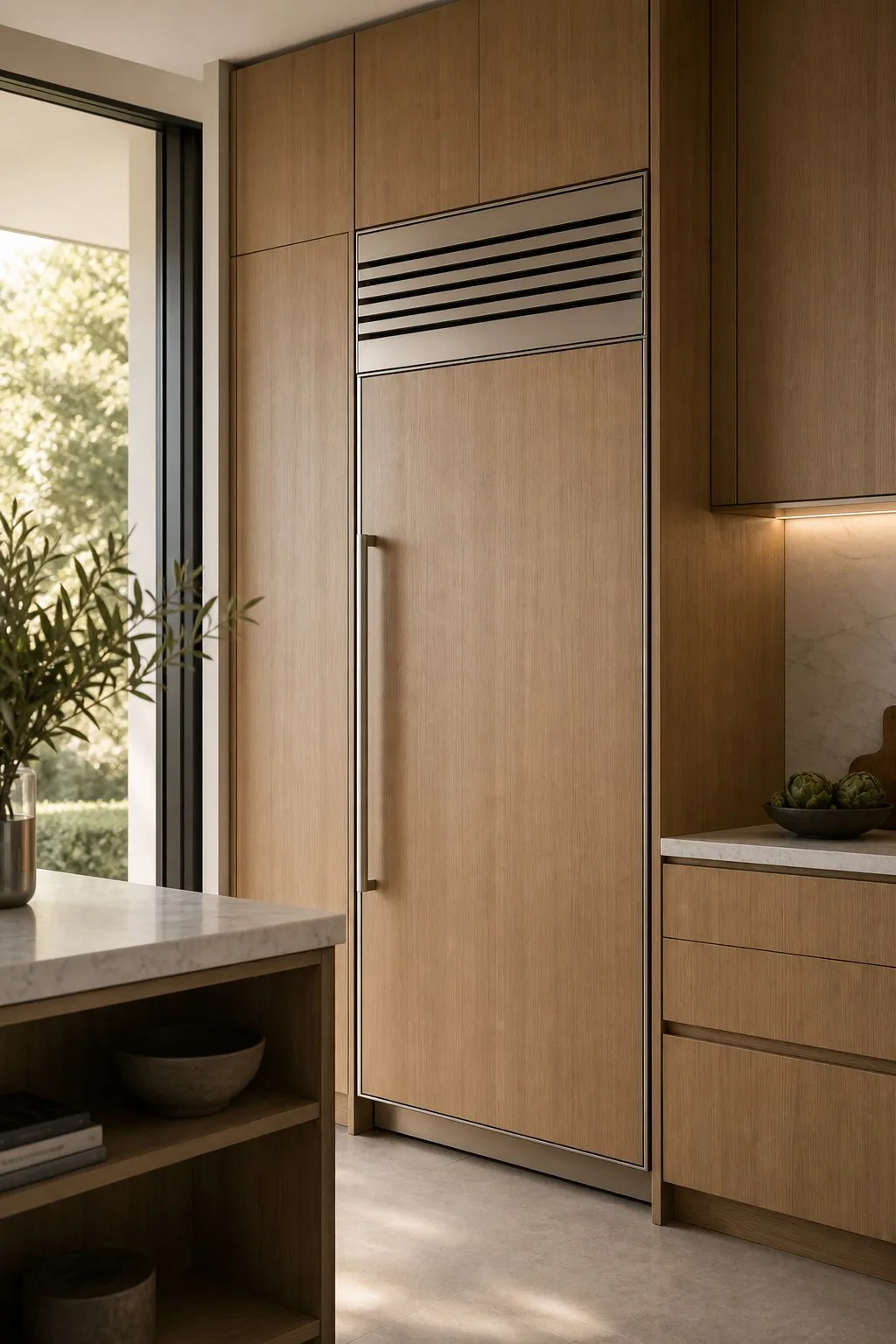
The hidden cost
The opening was framed to a model that no longer exists
Calculators compare appliance to appliance. Reality compares appliance to a custom-fitted hole. Many built-ins sit in cabinet returns cut to a discontinued unit's exact dimensions, wrapped in book-matched stone. A new unit can mean a different footprint, remade panels and a fabricator back on site — often more than the fridge itself.
Frequently asked questions
How long do high-end refrigerators last?
A well-maintained luxury built-in typically lasts 25–30 years — far longer than a mass-market fridge. Regular condenser cleaning and timely repairs are what reach the top of that range, which is why repair usually beats replacement on these units.
When is it not worth repairing?
Replace when multiple major components fail together — say a compressor and a control board and a leaking sealed system — or when a single repair would exceed roughly half the installed price of a new comparable unit. One major fault alone rarely justifies replacement.
Why does custom cabinetry change the decision?
A built-in is fitted to custom panels, trim and a precise cabinet opening. Replacing it can mean re-sizing the surround, new panels and reinstallation — costs a like-for-like price comparison hides. Keeping a repairable unit preserves that fitted kitchen.
Is a compressor failure a reason to replace?
Not by itself. On Sub-Zero the sealed system — compressor, condenser, evaporator, drier and tubing — carries a 12-year manufacturer warranty, so a compressor fault may cost far less than the sticker suggests. Verify warranty coverage before deciding.
What clients say
4.9 · 327 reviews
A salesman pushed us to replace our 12-year-old Sub-Zero over a compressor fault. This tech checked the serial, confirmed the sealed system was still under the 12-year warranty, and showed me the repair was well under half the installed price. We kept the unit and our custom panels — the honest math saved thousands.
Our built-in column sits in a stone surround cut to its exact opening. They explained that replacing it meant remade panels and a fabricator back on site — costs no calculator showed. With only one failed control board, repair was the clear call. A maintained unit reaches 25-30 years, and ours is good for a decade more.
I expected a sales pitch and got a candid breakdown instead. The technician laid out the 50 percent rule, weighed our two stacked failures against a comparable new built-in's installed price, and recommended replacement honestly. No upsell on a repair that wouldn't last. Wish they'd called sooner with the verdict.