
How do I keep a built-in refrigerator running for decades?
Do three things on a schedule: clean the condenser, change the water filter, and care for the door gaskets. A high-end built-in is engineered to last decades, but only if it isn’t quietly overworking. Most no-cooling calls we see trace back to a single skipped habit — usually a clogged condenser — and these three routines prevent the majority of failures and keep the sealed system from straining.
| Maintenance task | How often (Bay Area) | What it prevents |
|---|---|---|
| Clean the condenser coil | Every 3–6 mo inland/dusty; 6–12 mo elsewhere | A hot-running compressor and sealed-system failure |
| Change the water filter | Every 3–6 months | Slow water/ice and a scaled ice maker |
| Run the dollar-bill gasket test | Every 6 months | Warm-air leaks, frost at the seal, constant running |
| Verify both compartment temps | Every 6 months | Silent drift before food spoils (37°F / near 0°F) |
Why is cleaning the condenser the single most important chore?
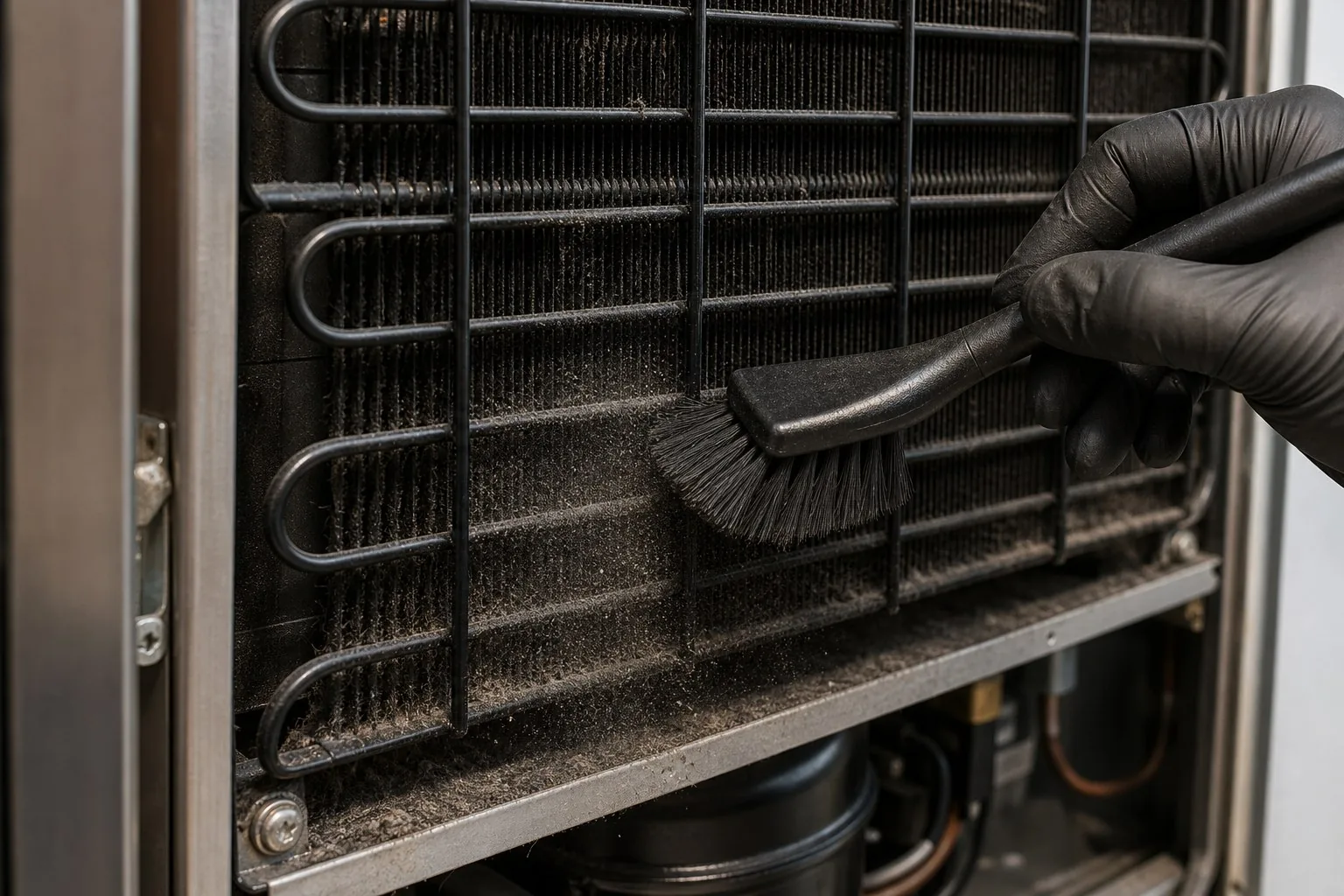
Because a clogged coil is what quietly destroys the compressor. The condenser rejects heat, and on a built-in it lives in a tight, top-mounted space behind the grille where dust collects fast. A clogged coil makes the compressor run long, temperatures drift, and minor faults snowball into no-cooling. Left long enough, a free five-minute chore becomes a sealed-system or compressor repair — the most expensive job on the repair cost guide.
- Most homes: clean every 6–12 months.
- Hot inland, dusty, or wildfire-season Bay Area homes: every 3–6 months. Diablo-wind dust and ash blanket coils far faster than coastal air.
Brush the coil and vacuum the debris; never bend the fins. If you’re unsure where the condenser is on your model, the model number guide and your rating plate point the way.
2. Change the water filter
A clogged filter slows water and ice and strains the system. Replace it every 3–6 months, or sooner if flow or taste drops. Hard Bay Area water shortens filter life and scales up ice makers, so don’t stretch the interval.
3. Care for the gaskets
Door gaskets are the cabinet’s weather seal. Wipe them clean so they stay supple, and test the seal with the dollar-bill test: close the door on a bill and tug — easy pull means a weak seal letting warm kitchen air leak in. A tired gasket shows up as condensation, frost at the seal, or a unit that runs constantly.
When maintenance isn’t enough
If you’ve cleaned the condenser, confirmed the seals, and given the unit 24 hours but the fresh-food side stays warm, it’s a fault — defrost, fan, damper or sensor — and it’s time for a diagnostic. A unit running constantly with both compartments warm is the classic Sub-Zero not-cooling pattern that maintenance alone won’t fix. When the math gets close, the honest comparison lives in repair vs replace, and the broader booking and cost questions are covered in our Bay Area repair answers. Maintenance prevents most problems; it doesn’t fix a failed component.
Your twice-a-year refrigerator check
- Pull the upper grille and look at the condenser coil — gray fuzz means it is overdue.
- Brush the coil downward and vacuum the loose dust; never bend the thin fins.
- Run the dollar-bill test on every door gasket and feel for cold leaks at the corners.
- Wipe gaskets with mild soap so the rubber stays supple and seals flat.
- Confirm interior vents are clear of stored food so cold air can circulate.
- Log the filter change date so you do not stretch past the six-month mark.
How to maintain a high-end refrigerator
- Clean the condenserFind the condenser behind the upper grille on a built-in, brush the coil clean, and vacuum the dust. Do this every 6–12 months — every 3–6 in hot, dusty or wildfire-season Bay Area conditions.
- Change the water filterReplace the water/ice filter every 3–6 months, or sooner if flow drops or taste changes. Hard Bay Area water shortens filter life and clogs ice makers.
- Care for the door gasketsWipe gaskets clean and check the seal with the dollar-bill test — close the door on a bill; if it pulls out easily the seal is weak. A failing gasket lets warm air in and overworks the system.
- Confirm airflow and temperaturesKeep interior vents unblocked and verify both compartments with an independent thermometer. Fresh-food around 37°F and freezer near 0°F is the target.
What clients say
4.9 · 327 reviews
After a smoky wildfire season our Sub-Zero ran warm. The tech pulled the upper grille and showed me a condenser coil packed with gray fuzz, brushed and vacuumed it, and walked me through the 3-to-6-month cleaning schedule for our inland home. Temperatures dropped back to 37 overnight. Smart preventive maintenance advice.
I'd never touched the condenser in eight years. They cleaned the choked coil, ran the dollar-bill test on every gasket, and confirmed both compartments held 37 and near 0. No part needed — just the upkeep that stops the compressor from running hot. Honest crew that didn't invent a repair.
Our hard water had scaled the ice maker and slowed the dispenser. The tech changed the overdue water filter, cleaned the condenser, and set me up with a twice-a-year maintenance checklist. He explained how skipped chores snowball into sealed-system calls. Ice flow returned to normal and the unit runs quieter.