
Quick answers
- Why is my Sub-Zero fridge warm but the freezer cold?
- Cold is made in the freezer and moved to the fresh-food side by a fan through a damper. If that airflow stops — iced evaporator, stalled fan, stuck damper — the freezer stays cold while the fridge warms. A dirty condenser makes it worse.
- What should I check first?
- Clean the condenser coils, confirm nothing blocks the interior vents, and make sure the doors seal. Give it 24 hours. If the fresh-food side is still warm, it needs a diagnostic — usually a defrost, fan, damper or thermistor fault.
- Is a warm fridge an emergency?
- If food is at risk, treat it as urgent. Move perishables, then book the soonest visit. A no-cooling Sub-Zero is a common same-day priority across much of the Bay Area depending on routing.
- How do I clean a Sub-Zero condenser?
- Pull the upper grille, then brush and vacuum the condenser from front to back to lift dust and pet hair. In dusty inland or wildfire-season conditions, repeat every three months. Never bend the fins or spray water into the unit.
Quick triage for a Sub-Zero that isn't cooling
- Clean the condenserBrush and vacuum the condenser coils; in dusty or wildfire-season Bay Area conditions, clean every 3–6 months.
- Check airflow and sealsMake sure interior vents aren't blocked and the door gaskets seal (the dollar-bill test).
- Wait 24 hoursGive the cabinet a full day to recover before judging — never change the setpoint mid-test.
- Book a diagnosticIf the fresh-food side stays warm, it's a defrost, fan, damper or thermistor fault — book a visit.
Why is my Sub-Zero cold in the freezer but warm in the fridge?
Because the cold is made in the freezer and only delivered to the fresh-food side — so an airflow fault leaves the freezer cold while the fridge drifts warm. Most built-in Sub-Zeros (BI-36, BI-42, BI-48 and the classic over-and-under cabinets) move that cold through an evaporator fan and a damper. When the delivery is interrupted, the freezer holds while the refrigerator climbs. That single fact narrows the diagnosis fast — and rules out a dead compressor, since a unit with no compressor would lose the freezer too. The reverse symptom matters just as much: if the freezer itself is warm while the fridge stays cold, the fault is on the cold-making side, not the airflow — that case lives on our Sub-Zero freezer not freezing page. (And when both sides go warm, our Sub-Zero freezer repair page covers the freezer-side picture.)
What causes a Sub-Zero fridge to run warm, in order?
The most likely culprit is the cheapest to rule out — a dirty condenser — followed by airflow faults:
- Dirty condenser — the most common and the cheapest to rule out. The coil sits behind the upper grille and slowly chokes on dust, so the system runs long and inefficient.
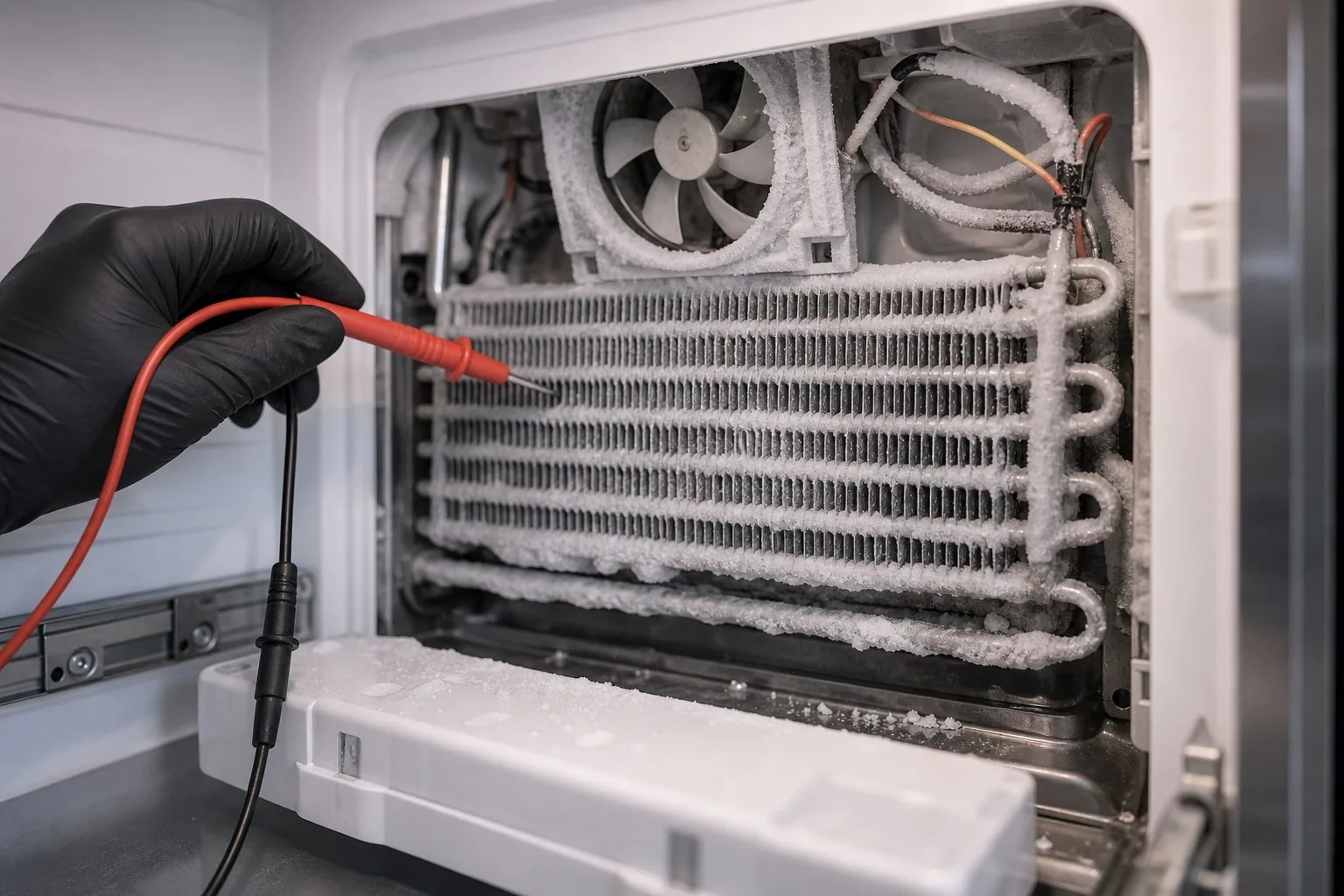
- Defrost failure — frost builds on the evaporator and blocks the airflow path to the fridge.
- Evaporator fan motor — no fan, no cold air moved into the fresh-food side.
- Stuck damper — the air door between freezer and fridge won’t open on demand.
- Drifted thermistor — the board misreads cabinet temperature and stops cooling early.
A 24-hour temperature log of both compartments usually tells us which of these it is before we arrive, so we can load the truck for the actual fault and fix it in one trip.
Symptom to likely cause
| Symptom or sign | Likely cause | What we do |
|---|---|---|
| Fridge warm, freezer cold, no frost visible | Stalled evaporator fan or stuck damper | Test the fan and damper, fit a genuine OEM part |
| Fridge warm with a thick ice slab on the evaporator | Defrost failure (heater, terminator or control) | Read the frost, replace the failed defrost component |
| Both compartments slowly warming | Dust- or ash-loaded condenser | Deep-clean the coil, then re-check airflow and seals |
| Cools, then quits early or short-cycles | Drifted thermistor feeding bad readings | Test against spec, swap the OEM thermistor |
| Won’t cool and an error appears | Sensor or board fault | Cross-check our Sub-Zero error codes list and diagnose |
If you’d rather work through it yourself first, the Sub-Zero troubleshooting guide walks each step in order.
Why this happens in Bay Area kitchens
Local conditions push Sub-Zero condensers harder than the manual assumes. In the Tri-Valley and inland East Bay, summer kitchens sit at 90–100°F, so a coil already loaded with dust simply can’t shed heat fast enough and the fresh-food side is the first compartment to suffer. Wildfire-season ash and fine grit settle into that same front grille within weeks, and homes with pets compound it. Closer to the coast and the fog line, salt-laden air corrodes condenser tubing and fan bearings over time, which is why a stalled evaporator fan turns up more often on Peninsula and Marin units. Hard water across much of the region scales the defrost components and ice circuit, accelerating the defrost and thermistor faults above.
Many of these refrigerators are built into estate kitchens with custom panels, stone surrounds and tight cabinet returns, so condenser airflow is unforgiving and a botched pull can scratch a fitted panel. We carry genuine OEM parts matched to the model on the rating plate, and we work around gated, hillside and white-glove-access homes by appointment so the repair is done once, cleanly, and to spec. Most no-cooling fixes fall in the non-sealed band on our repair cost page, and the broader service overview lives on our Sub-Zero repair page. A flat $89 service call applies and is waived with any repair.
Frequently asked questions
Why is my Sub-Zero fridge warm but the freezer cold?
Cold is made in the freezer and moved to the fresh-food side by a fan through a damper. If that airflow stops — iced evaporator, stalled fan, stuck damper — the freezer stays cold while the fridge warms. A dirty condenser makes it worse.
What should I check first?
Clean the condenser coils, confirm nothing blocks the interior vents, and make sure the doors seal. Give it 24 hours. If the fresh-food side is still warm, it needs a diagnostic — usually a defrost, fan, damper or thermistor fault.
Is a warm fridge an emergency?
If food is at risk, treat it as urgent. Move perishables, then book the soonest visit. A no-cooling Sub-Zero is a common same-day priority across much of the Bay Area depending on routing.
How do I clean a Sub-Zero condenser?
Pull the upper grille, then brush and vacuum the condenser from front to back to lift dust and pet hair. In dusty inland or wildfire-season conditions, repeat every three months. Never bend the fins or spray water into the unit.
What clients say
4.9 · 327 reviews
Our Sub-Zero fresh-food side was warm but the freezer stayed cold. The technician explained cold is made in the freezer and a fan moves it up, then traced it to a stalled evaporator fan that had stopped delivering air. OEM part on the truck, fixed that evening, no parts-cannon guessing.
Fridge drifting warm while the freezer was fine. He cleared the dust-choked condenser behind the upper grille first, then found frost icing the evaporator from a defrost failure and a stuck damper. Both corrected in one visit. Honest that the condenser alone wasn't the whole story.
I sent a 24-hour temperature log before the visit and it paid off. The fresh-food compartment kept climbing into the mid-40s while the freezer held zero, pointing to airflow. He arrived with the right damper and thermistor, found a drifted thermistor, and our Sub-Zero is cooling properly again.