
How does a Viking oven actually heat?
A Viking Professional oven makes heat one of two ways. All-gas ovens use a glow-bar igniter: when you call for heat the igniter draws current and glows white-hot, and only once it’s hot enough does the safety valve open and the burner light. Dual-fuel and electric models use bake and broil elements instead, with a temperature sensor feeding the control so it cycles the elements to hold your setpoint, plus a convection fan to move the heat. Knowing which type sits in your kitchen narrows the fault fast — and on a gas model, the igniter is nearly always the first suspect.
Symptom, likely cause, and what we do
| Symptom or sign | Likely cause | What we do |
|---|---|---|
| Oven slow to light or won’t light (gas) | Weak glow-bar igniter, can’t open the safety valve | Measure amp draw vs. spec, replace with genuine OEM igniter |
| Broils but won’t bake | Lower bake element or its igniter failed | Resistance-test each circuit, replace only the dead one |
| Climbs partway then stalls below setpoint | Drifted temperature sensor cutting heat early | Test sensor resistance vs. spec, recalibrate or replace |
| Heats but bakes unevenly | Convection fan or rear element fault | Check fan and element, replace the failed part |
| Smell of gas before it lights | Igniter too slow, dumping unburned gas | Stop use, test igniter and safety valve, replace |
A flashing display or fault code alongside no-heat is a separate path — match it on the Viking error codes page before assuming a heating part.
Real causes, in order
- Weak glow-bar igniter — the most common no-heat cause on gas Viking ovens; it can no longer pull enough current to open the safety valve, so the burner never lights.
- Failed bake or broil element — on dual-fuel and electric ovens, a blistered or broken element stops heating or heats unevenly.
- Drifted temperature sensor — the control misreads cavity heat and cycles off early.
- Convection fan or rear element fault — heat doesn’t circulate, so baking runs uneven.
- Control fault — least common; tested only after the others check out.
Is it the igniter, the element, or the sensor?
These three failures look different once you know what to watch. A weak igniter fails gradually — the oven still lights, but slowly, and on the worst days won’t open the safety valve at all, so the symptom comes and goes with weather and gas pressure. A failed electric element usually quits all at once and is often visibly blistered or broken. A drifted sensor reads wrong but looks fine. We test each against its real resistance and amp-draw spec rather than swapping parts on a hunch, so the Viking oven repair is one trip with the right genuine OEM part matched to the model on the rating plate — and you get a flat repair cost in writing first.
Why do Viking ovens fail this way in Bay Area kitchens?
Because the way a Viking Professional range lives here shapes how it fails. It anchors most Tri-Valley, Peninsula and Silicon Valley estate kitchens, and inland summers at 90–100°F push a kitchen hard, so a marginal igniter is far likelier to quit on a hot San Ramon afternoon than on a mild morning. Hard water across much of the region scales steam and self-clean components and shortens igniter life. Closer to the coast and the fog line, salt-laden air corrodes igniter leads and element terminals, so coastal Peninsula and Marin ovens tend toward intermittent, weather-driven no-heats. The same conditions affect refrigeration too, so a no-heat oven call often pairs with a Viking refrigerator not cooling check on the same visit.
These ranges are also dropped into custom surrounds with fitted panels and tight returns, so a clean pull matters. We work gated, hillside and white-glove-access estate homes by appointment, and check the neighbors of any failed part while the oven is open — so the fix holds next time you preheat.
Quick answers
- Why won't my Viking oven reach the temperature I set?
- A Viking oven that climbs partway then stalls is usually fighting a weak gas igniter that opens the valve late, a partly failed bake element, or a temperature sensor reading too high so the control cuts heat early. We test the igniter draw, element resistance and sensor against spec to find which one is short.
- How long should a Viking gas oven take to ignite?
- A healthy Viking glow-bar igniter should heat and light the burner within about 30 to 90 seconds. If yours takes several minutes, clicks without lighting, or you smell gas with no flame, the igniter has lost the current draw needed to open the safety valve and should be replaced before further use.
- My Viking oven broils but won't bake — what's wrong?
- If the broil element heats from the top but the oven won't bake, the lower bake element or its igniter has failed while the broil circuit still works. Each has its own element or burner and igniter, so one can quit while the other runs. We verify which circuit is dead before quoting the part.
- Is a failed igniter or a bad control board more likely on a Viking oven?
- The igniter, by a wide margin. Glow-bar igniters weaken with every heat cycle and are the most common Viking no-heat fault. We only test the control after the igniter, element and sensor check out against spec, since boards fail far less often than the parts they switch.
Diagnosis
We test draw, not appearance
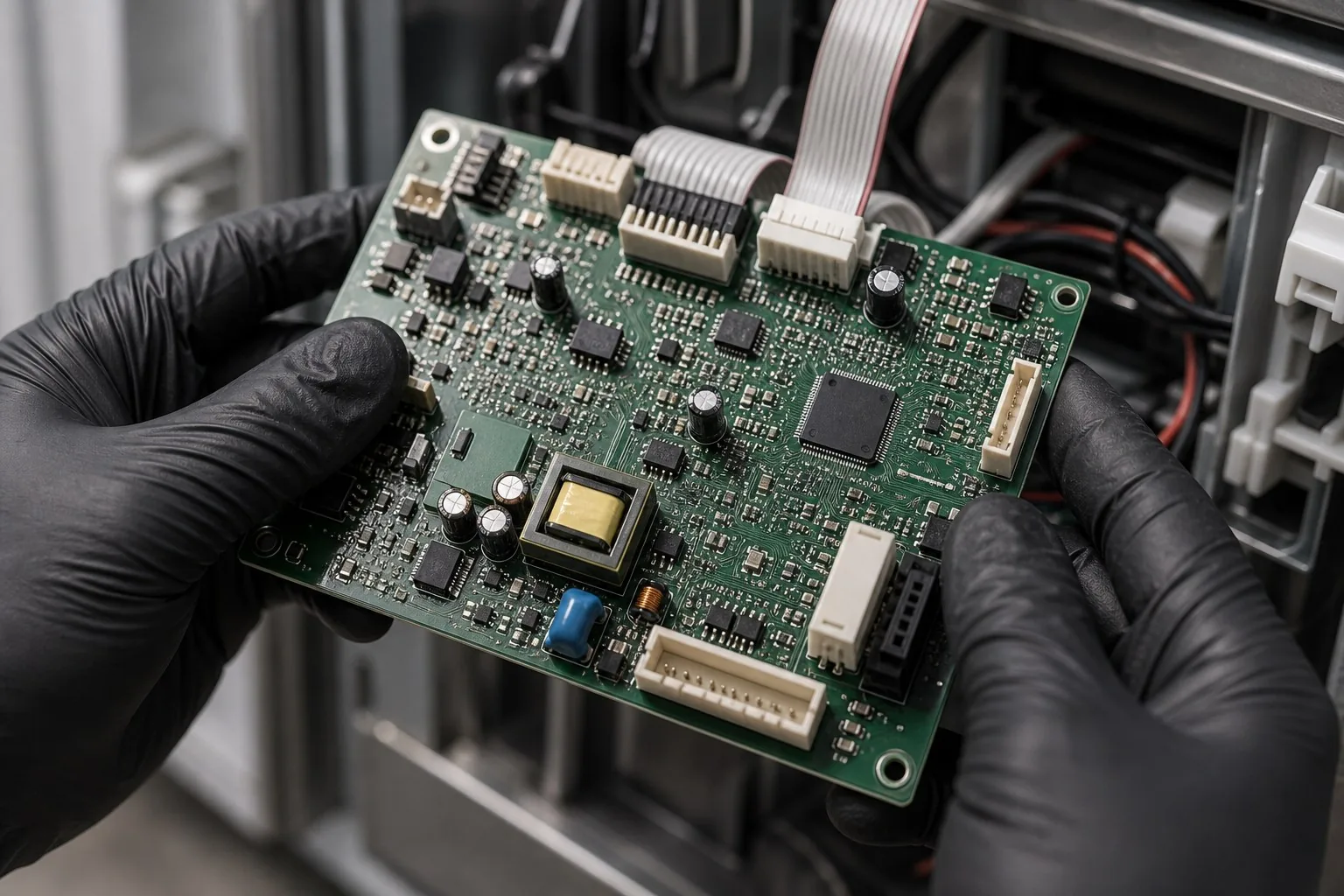
A glow-bar igniter can glow bright orange and still fail — what matters is the current it pulls, because that current is what opens the safety gas valve. A weak igniter heats but never reaches the threshold, so the burner never lights. We measure amp-draw against spec rather than judging by the glow.
Quick checks before booking a no-heat call
- Confirm the oven breaker is on and not tripped
- Verify the gas supply valve is fully open
- Note whether the igniter glows, clicks, or does nothing
- Time how long ignition takes — minutes means a dying igniter
- Check whether broil works but bake doesn't, or vice versa
- Stop using the oven if you smell gas before it lights
Frequently asked questions
Why won't my Viking oven reach the temperature I set?
A Viking oven that climbs partway then stalls is usually fighting a weak gas igniter that opens the valve late, a partly failed bake element, or a temperature sensor reading too high so the control cuts heat early. We test the igniter draw, element resistance and sensor against spec to find which one is short.
How long should a Viking gas oven take to ignite?
A healthy Viking glow-bar igniter should heat and light the burner within about 30 to 90 seconds. If yours takes several minutes, clicks without lighting, or you smell gas with no flame, the igniter has lost the current draw needed to open the safety valve and should be replaced before further use.
My Viking oven broils but won't bake — what's wrong?
If the broil element heats from the top but the oven won't bake, the lower bake element or its igniter has failed while the broil circuit still works. Each has its own element or burner and igniter, so one can quit while the other runs. We verify which circuit is dead before quoting the part.
Is a failed igniter or a bad control board more likely on a Viking oven?
The igniter, by a wide margin. Glow-bar igniters weaken with every heat cycle and are the most common Viking no-heat fault. We only test the control after the igniter, element and sensor check out against spec, since boards fail far less often than the parts they switch.
Can I keep cooking on a Viking oven that takes forever to heat?
No. A slow-heating gas oven is usually a dying igniter that can dump unburned gas into the cavity before it lights, which is a safety risk. Stop using the oven, confirm the breaker and gas valve are on, and book a diagnostic so the igniter and safety valve are tested properly.
Does the convection fan affect whether my Viking oven heats?
It affects how evenly it heats, not whether it heats at all. If the oven reaches temperature but bakes hot on one side or scorches edges, the convection fan or its element is the suspect, not the bake circuit. We confirm the configuration from the rating plate before replacing any single part.
What clients say
4.9 · 327 reviews
My Viking gas oven took several minutes to light and sometimes never did. The tech measured the glow-bar igniter's amp draw rather than judging by the glow, found it too weak to open the safety valve, and swapped in an OEM igniter. It lights in under a minute now and the intermittent no-heat is gone.
Our dual-fuel Viking broiled fine but wouldn't bake. He confirmed the lower bake element was dead with a resistance test while the broil circuit still worked, then replaced just that element. He checked the temperature sensor against spec too. One trip, right diagnosis, and the oven reaches temperature again.
The Viking oven climbed partway then stalled below my setpoint. Turned out the temperature sensor had drifted high so the control cut heat early — not the igniter I assumed. He tested the igniter and element first to be sure, then replaced the sensor. Slightly late arrival, but the oven holds temperature perfectly now.