
Quick answers
- Why is my Viking refrigerator not getting cold?
- The usual causes are a dirty condenser, a stalled evaporator fan, a defrost failure that ices the evaporator and blocks airflow, or a drifted thermistor that makes the control stop cooling early. Clean the condenser first, then give it 24 hours before assuming a part has failed.
- What should I check first on a warm Viking fridge?
- Brush and vacuum the condenser, confirm nothing blocks the interior vents, and check that the door gaskets seal with the dollar-bill test. Make sure the unit hasn't been bumped off its setpoint. Give it a full 24 hours to recover before deciding it needs service — never change the setpoint mid-test.
- Where is the condenser on a Viking built-in refrigerator?
- On Viking built-in and column refrigeration the condenser sits behind the upper louvered grille, where it pulls air down through the cabinet face. Freestanding Viking units vent lower or at the rear. Either way, that grille is the first thing we clear — a choked coil is the most common warm-cabinet cause.
- Why does my Viking fridge cool fine in winter but run warm in summer?
- Viking refrigeration is sized for a normal kitchen, not a 95-degree inland Bay Area afternoon. When ambient heat climbs and the condenser is even slightly dust-loaded, the compressor can't reject heat fast enough and the fresh-food side warms first. Cleaning the grille usually restores cooling before a part is suspected.
Reading the frost
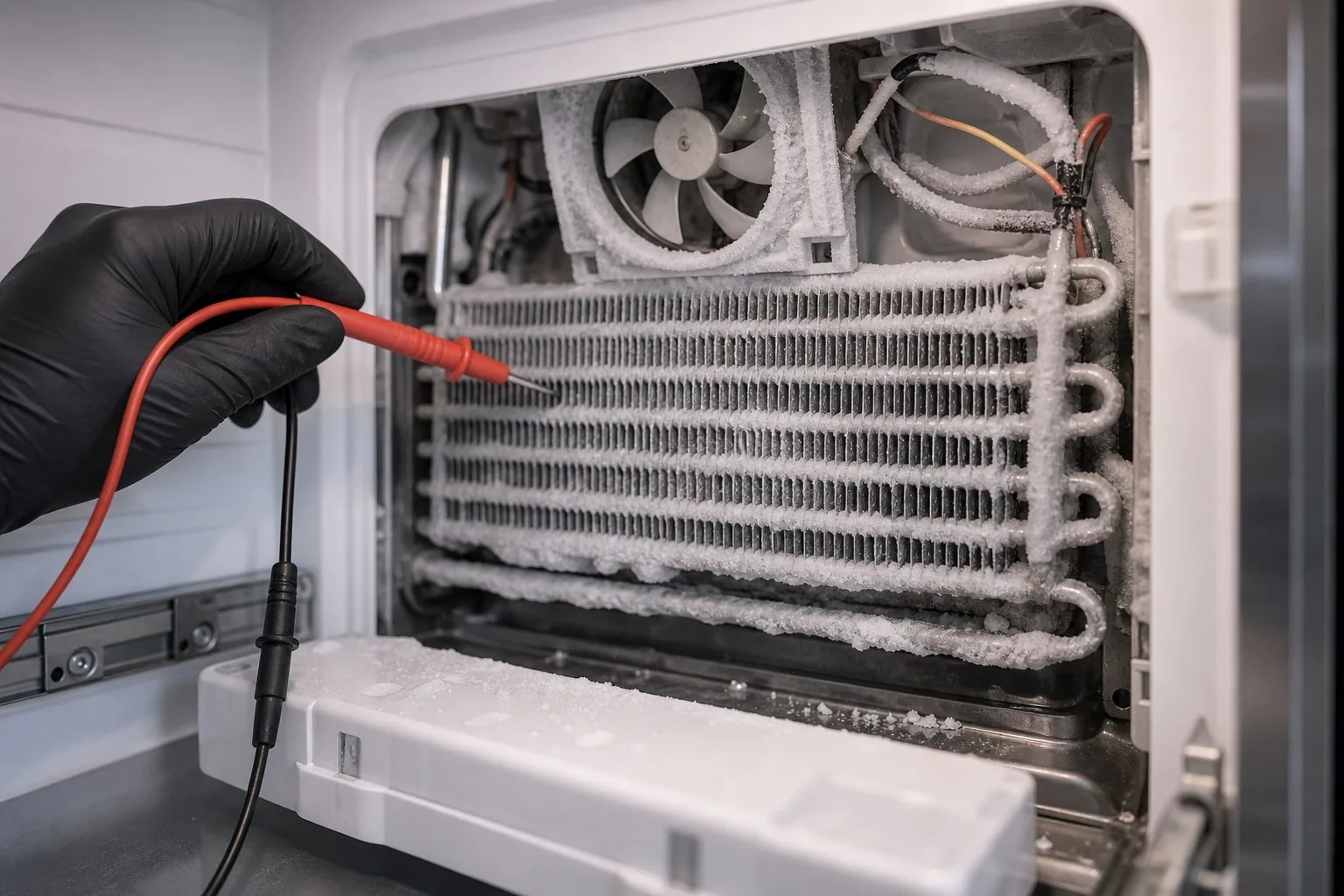
A solid sheet of evaporator ice is a defrost story
When the fridge warms but the freezer stays cold, pull the rear freezer panel and look at the evaporator. Light, even frost is normal; a thick white slab encasing the coil means the defrost cycle has quit and ice is now blocking the airflow that feeds the fresh-food side. That points at the heater, terminator or defrost control — not the compressor.
Behind the grille
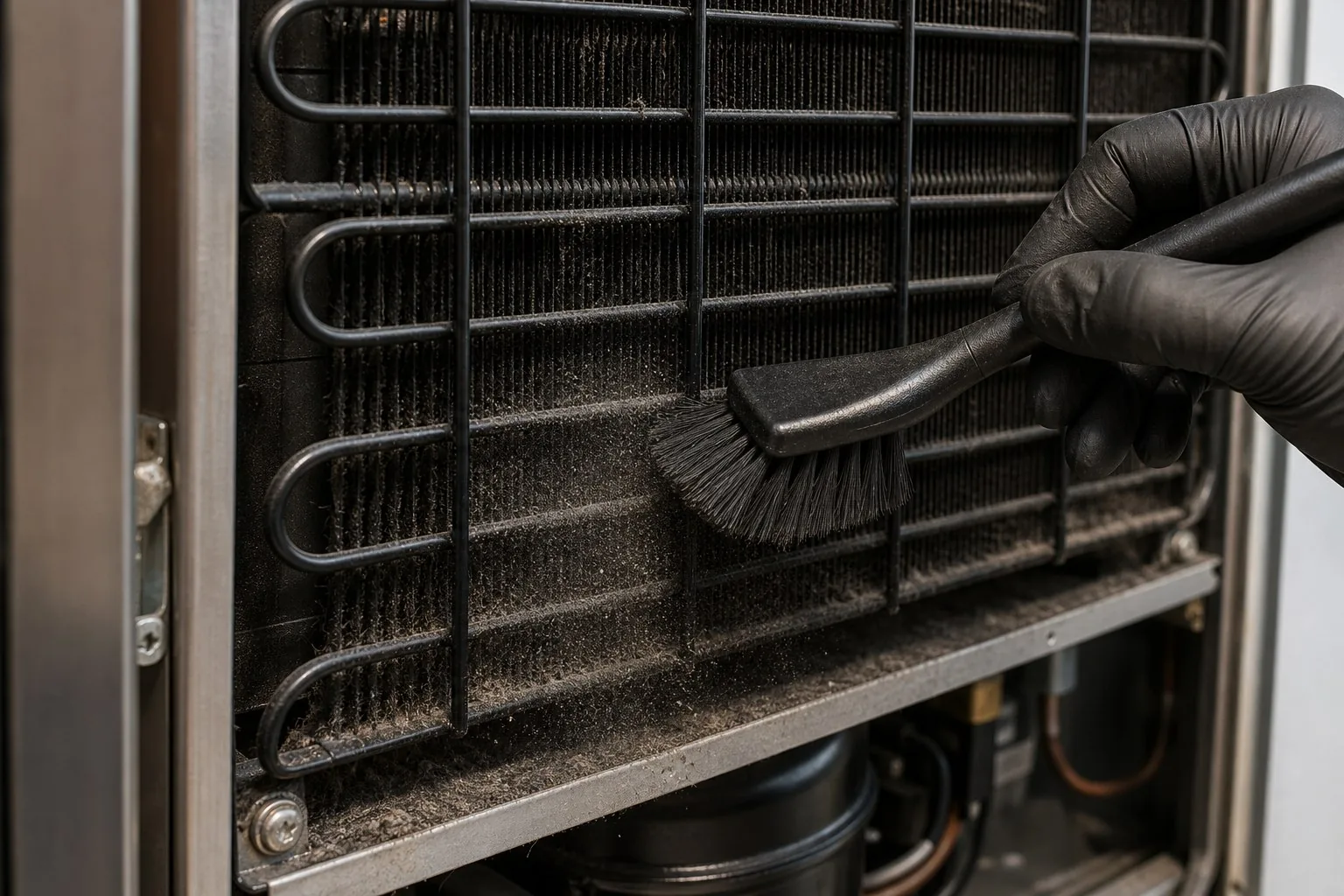
Why we clear the upper louvers first
On Viking built-in and column units the condenser breathes through the upper louvered grille. Pull it and you often find a dust mat sealing the fins. A coil that can't shed heat makes the compressor run long and hot, and the fresh-food side is what warms first — which is why cleaning the grille fixes more warm-cabinet calls than any single part replacement.
How does a Viking refrigerator make cold?
It makes cold at the evaporator and moves it where it’s needed with an evaporator fan, while the condenser sheds the heat the compressor pumps out. A thermistor reports cabinet temperature so the control knows when to cool, and a defrost cycle periodically melts frost off the evaporator so air keeps flowing. When any link in that chain fails, the cabinet runs warm — and which compartment is affected tells us where to look. The same airflow logic drives a Sub-Zero not cooling call, so the triage steps below carry across both brands.
Built-in vs. freestanding Viking refrigeration
The fix often starts with how the unit is installed. Viking built-in and column models pull condenser air through the upper louvered grille and shed heat out the front, so a blocked or dust-packed grille strangles cooling fast. Freestanding Viking refrigerators usually carry the condenser lower or at the rear, where pet hair and cabinet dust collect. The rating plate that identifies your exact model and series lives inside the cabinet near the upper hinge or on the sidewall — we read it before ordering any genuine OEM part so the repair matches the unit.
What causes a Viking refrigerator to run warm, in order?
The most likely cause is also the cheapest to rule out — a dirty condenser — then airflow faults:
- Dirty condenser — the most common and cheapest to rule out; clean it first.
- Stalled evaporator fan — no fan means no cold air moved to the fresh-food side.
- Defrost failure — frost builds on the evaporator and chokes airflow.
- Drifted thermistor — the control misreads temperature and stops cooling early.
- Sealed-system loss — a weak compressor or low charge warms both compartments.
Read the symptom
A freezer that stays cold while the fridge warms points to an airflow fault — fan, defrost or damper. Both compartments warm together points toward the condenser or the sealed system.
Viking warm-cabinet symptoms at a glance
| Symptom or sign | Likely cause | What we do |
|---|---|---|
| Fresh-food side warm, freezer cold, no frost | Stalled evaporator fan or stuck damper | Test airflow, fit a genuine OEM fan or damper |
| Fridge warm with a thick ice slab on the coil | Defrost failure (heater, terminator, control) | Read the frost, replace the failed defrost part |
| Both compartments warming, runs nonstop | Dust- or ash-loaded condenser | Clear the upper louvers, deep-clean the coil |
| Cools then quits early | Drifted thermistor | Test against spec, swap the OEM thermistor |
| Warm in summer only | Heat plus a slightly dusty condenser | Clean the grille, confirm before suspecting a part |
| A code shows on the display | Sensor or control fault | Cross-check our Viking error codes and diagnose |
Why this happens in Bay Area kitchens
Viking refrigeration is sized for a normal kitchen, not a Tri-Valley or inland East Bay summer where estate kitchens sit at 90–100°F. A coil already loaded with dust can’t shed that heat, and the fresh-food side suffers first. Wildfire-season ash packs the same grille within weeks, and homes with pets compound it. Near the coast and fog line, salt-laden air corrodes condenser tubing and fan bearings, so stalled evaporator fans turn up more often on Peninsula and Marin units. Hard water across the region scales defrost and ice components, speeding the defrost and thermistor faults above.
When to call
If the condenser is clean, the vents are clear, the doors seal, and the cabinet is still warm after a full 24 hours, it needs a diagnostic. We test the evaporator fan, defrost components and thermistor against spec, and check the sealed system if both sides are warm, so the repair targets the real fault. A 24-hour temperature log of both compartments helps us load the truck before we arrive — and we work around gated, hillside and white-glove-access estate homes by appointment. Most warm-cabinet fixes fall in the non-sealed band on our repair cost page, the full service overview lives on our Viking repair page, and a flat $89 service call applies and is waived with any repair.
Frequently asked questions
Why is my Viking refrigerator not getting cold?
The usual causes are a dirty condenser, a stalled evaporator fan, a defrost failure that ices the evaporator and blocks airflow, or a drifted thermistor that makes the control stop cooling early. Clean the condenser first, then give it 24 hours before assuming a part has failed.
What should I check first on a warm Viking fridge?
Brush and vacuum the condenser, confirm nothing blocks the interior vents, and check that the door gaskets seal with the dollar-bill test. Make sure the unit hasn't been bumped off its setpoint. Give it a full 24 hours to recover before deciding it needs service — never change the setpoint mid-test.
Where is the condenser on a Viking built-in refrigerator?
On Viking built-in and column refrigeration the condenser sits behind the upper louvered grille, where it pulls air down through the cabinet face. Freestanding Viking units vent lower or at the rear. Either way, that grille is the first thing we clear — a choked coil is the most common warm-cabinet cause.
Why does my Viking fridge cool fine in winter but run warm in summer?
Viking refrigeration is sized for a normal kitchen, not a 95-degree inland Bay Area afternoon. When ambient heat climbs and the condenser is even slightly dust-loaded, the compressor can't reject heat fast enough and the fresh-food side warms first. Cleaning the grille usually restores cooling before a part is suspected.
How often should I clean a Viking condenser?
Clean the condenser every three to six months, more often in dusty inland Bay Area conditions or during wildfire season when ash loads the coils. A clogged condenser is the most common and cheapest cause of poor cooling, so it's always the first thing to rule out before booking a diagnostic.
What clients say
4.9 · 327 reviews
Our Viking built-in ran warm on the fresh-food side all summer. They pulled the upper louvered grille and found a dust mat sealing the condenser fins, cleaned it, and after the 24-hour recovery it held setpoint. Cheapest possible fix — no part needed, no pressure to replace anything.
Fridge warming while the freezer stayed cold. The tech pulled the rear freezer panel, saw a thick slab of ice encasing the evaporator, and traced it to a failed defrost terminator. OEM part installed, airflow restored, fresh-food side cold again. Read the frost exactly right.
Our Viking cooled fine in winter but ran warm in our hot kitchen. They confirmed the condenser was clear, then found a stalled evaporator fan from a worn bearing — common near the coast. Genuine OEM motor in, the cabinet held temperature. Logged both compartments before arriving.