
Quick answers
- How does wildfire ash affect a refrigerator condenser?
- Wildfire ash is far finer than household dust — often under 10 microns — so it slips through the upper grille and bonds to the condenser fins in a greasy film rather than lifting off. That film insulates the coil, so the Sub-Zero compressor runs longer and hotter and the fresh-food side warms first.
- How fast does smoke season clog a Sub-Zero condenser in the Bay Area?
- During an active Diablo-wind smoke event a Sub-Zero condenser can choke in two to four weeks, against the three to six months ordinary Tri-Valley dust takes. The coil sits behind the louvered upper grille and pulls in ceiling-line air, so it captures the heaviest ash a kitchen draws in.
- What are the signs my Sub-Zero condenser is dust- or smoke-clogged?
- The unit runs nearly nonstop, the upper grille feels hot, the fresh-food side drifts above 40°F while the freezer holds, and a gray felt is visible on the coil. In smoke season these signs appear within weeks, not months, so an inland kitchen should check the grille monthly.
- Should I clean my Sub-Zero condenser more often during wildfire season?
- Yes. Drop the interval to monthly while smoke is in the air, then return to every three to six months once skies clear. Run the kitchen on recirculate, keep windows shut during Diablo-wind events, and inspect the upper-grille coil after any multi-day smoke episode before run times climb.
The mechanism
Why ash chokes a coil faster than dust
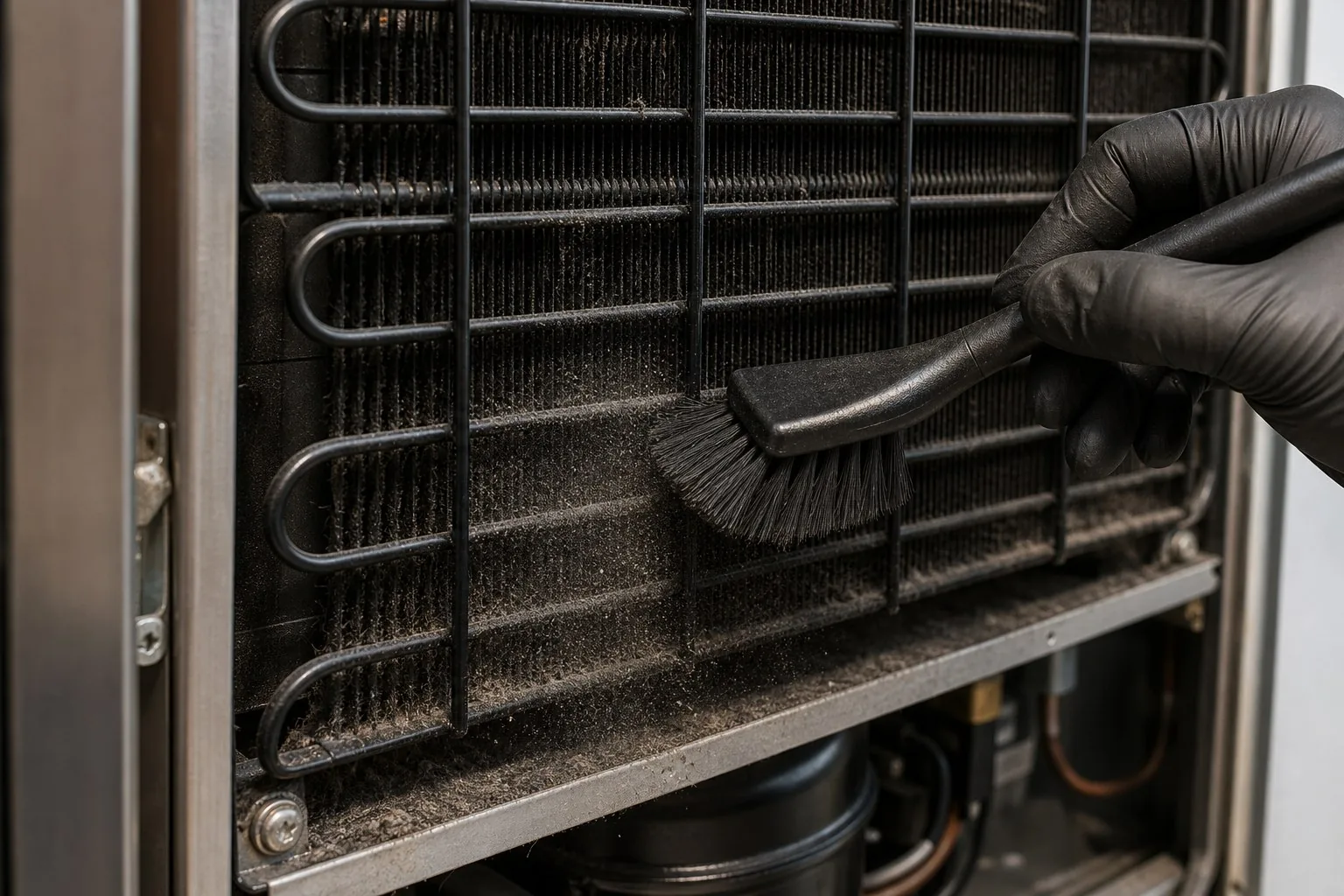
Household dust is coarse and brushes off; wildfire ash is sub-10-micron and carries an oily combustion film that makes it cling to the aluminum fins. Behind the louvered upper grille of a BI-36, BI-42 or BI-48, the coil draws the ceiling-line air where the heaviest ash floats, so a Diablo-wind week can lay down what normally takes a season.
The real risk
From a gray coil to a strained compressor
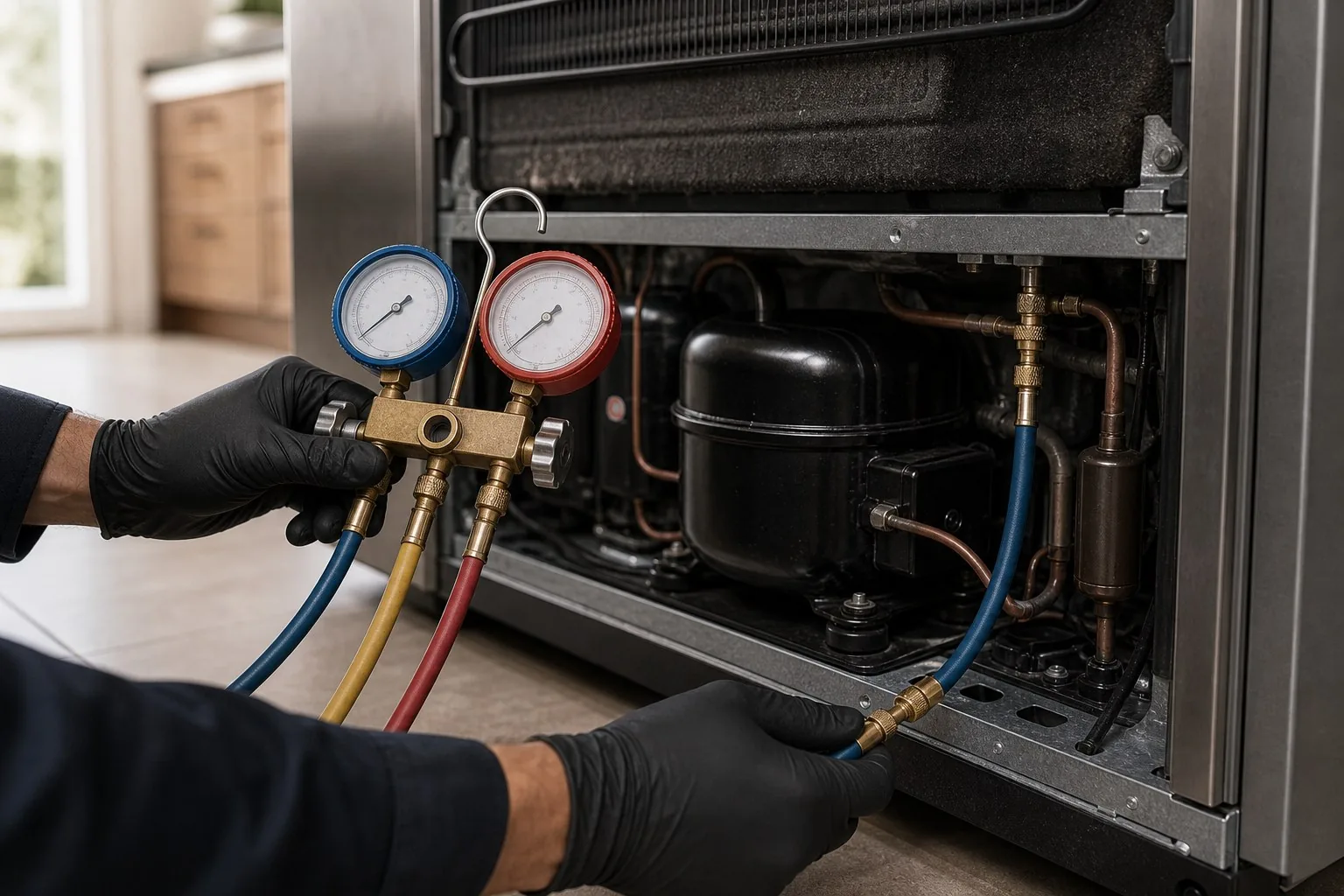
Ash never touches the refrigerant, but an insulated condenser cannot shed heat, so the compressor runs long and its discharge temperature and amp-draw climb. Sustained across a smoke season, that heat is the quiet path to a sealed-system fault — the very compressor, drier and tubing the 12-year warranty covers — which is why coil care is cheap insurance.
Smoke-season condenser checklist for inland kitchens
- Drop the upper-grille coil check to monthly while smoke or Diablo-wind ash is in the air
- Brush and vacuum the condenser fins dry — never wet ash into a paste on the coil
- Run HVAC on recirculate and keep windows shut during active smoke to cut the ash the grille draws
- Inspect the coil after any multi-day smoke episode, before run times start climbing
- Watch for a hot grille, near-nonstop running and a fresh-food side drifting above 40°F
- Book a sealed-system diagnostic if amp-draw stays high after a thorough cleaning
Why does wildfire ash clog a Sub-Zero condenser so fast?
Because wildfire ash is far finer than household dust — most particles measure under ten microns — so instead of resting loosely on the upper-grille coil where a vacuum lifts it, it slips between the fins and bonds in a thin, oily combustion film that insulates the condenser like a blanket on a radiator. On a built-in Sub-Zero the coil sits behind the louvered grille at the top of the cabinet and draws ceiling-line kitchen air, exactly where the heaviest smoke collects. So a Bay Area Diablo-wind event can lay down in two to four weeks what ordinary inland dust takes a season to deposit — leaving a compressor that runs long and hot and a fresh-food side that drifts warm first.
What are the warning signs during smoke season?
The first sign is run time: the unit barely cycles off and the upper grille feels hot to the hand. Next the fresh-food compartment climbs above 40°F while the freezer still holds, because the condenser’s lost capacity hits the fridge side first. Pull the grille and you may see a gray felt over the aluminum fins — bonded ash, not loose dust. In an inland kitchen these signs surface within weeks of a smoke episode, so the trigger to act is the weather, not the calendar. If you have already cleaned the coil and the cabinet stays warm, the load has tipped into a Sub-Zero not cooling call that needs a technician’s gauges, not another scrub.
| Sign during smoke season | What it means | What to do |
|---|---|---|
| Runs nearly nonstop, grille hot | Coil insulated by bonded ash | Clean the upper-grille coil dry now |
| Fresh-food side above 40°F, freezer cold | Lost condenser capacity hitting the fridge first | Check the coil; if still warm 24 hrs later, book a diagnostic |
| Gray felt over the fins | Bonded combustion film, not loose dust | Brush down and vacuum dry — never water or spray |
| Short-cycling after a smoke event | Heat-stressed compressor | Have amp-draw and discharge temperature read |
| Coil reclogs within weeks of cleaning | Active ash load in the air | Drop to a monthly check until skies clear |
What is the real cleaning cadence in the Tri-Valley?
Outside smoke season, every three to six months suits the inland Bay Area — the schedule the Sub-Zero maintenance in San Ramon plan follows. But when Diablo winds drive foothill ash toward Danville, Blackhawk and Diablo, that interval collapses: check the upper-grille coil monthly until the air clears. The cleaning method itself does not change — dry brush downward, then vacuum, per the Sub-Zero condenser cleaning walkthrough — only the frequency rises. Between cleanings, lower the ash the grille inhales: keep windows shut during wind events, run HVAC on recirculate, and change furnace filters. The coil draws kitchen air regardless, so a cleaner kitchen is a cleaner condenser.
Why this matters for the sealed system
A smothered condenser is a heat problem, and heat is what ages a sealed system. When ash insulates the coil, the compressor cannot reject heat, so its discharge temperature and amp-draw climb and stay high through a smoke season. Ash never reaches the refrigerant, but that sustained thermal stress is the quiet path toward a failed compressor, drier or tubing — the components Sub-Zero’s 12-year sealed-system warranty covers, detailed on our Sub-Zero sealed-system and compressor page. A monthly grille check during fire season is the cheapest insurance against a $900-$2,000 sealed-system repair. Local Danville, Blackhawk and San Ramon addresses get the fastest Tri-Valley routing; a flat $89 service call applies and is waived with any repair, most non-sealed fixes landing in the $200-$700 band.
Service area
Where we work — the Bay Area service area
From our Tri-Valley base we cover the entire San Francisco Bay Area — choose your region for local detail.
Frequently asked questions
How does wildfire ash affect a refrigerator condenser?
Wildfire ash is far finer than household dust — often under 10 microns — so it slips through the upper grille and bonds to the condenser fins in a greasy film rather than lifting off. That film insulates the coil, so the Sub-Zero compressor runs longer and hotter and the fresh-food side warms first.
How fast does smoke season clog a Sub-Zero condenser in the Bay Area?
During an active Diablo-wind smoke event a Sub-Zero condenser can choke in two to four weeks, against the three to six months ordinary Tri-Valley dust takes. The coil sits behind the louvered upper grille and pulls in ceiling-line air, so it captures the heaviest ash a kitchen draws in.
What are the signs my Sub-Zero condenser is dust- or smoke-clogged?
The unit runs nearly nonstop, the upper grille feels hot, the fresh-food side drifts above 40°F while the freezer holds, and a gray felt is visible on the coil. In smoke season these signs appear within weeks, not months, so an inland kitchen should check the grille monthly.
Should I clean my Sub-Zero condenser more often during wildfire season?
Yes. Drop the interval to monthly while smoke is in the air, then return to every three to six months once skies clear. Run the kitchen on recirculate, keep windows shut during Diablo-wind events, and inspect the upper-grille coil after any multi-day smoke episode before run times climb.
Can wildfire ash damage a Sub-Zero sealed system?
Indirectly, yes. Ash never reaches the refrigerant, but a smothered condenser forces the compressor to run long and hot, raising amp-draw and discharge temperature. Sustained over a smoke season that heat stress is what can age a sealed system — the compressor, drier and tubing covered by the 12-year warranty — toward early failure.
Does running my Sub-Zero on recirculate during smoke help the condenser?
It helps the kitchen, not the coil directly. The condenser draws kitchen air regardless, so closing windows, running HVAC on recirculate, and changing furnace filters lowers the ash load the grille sees. Pair that with a monthly coil check and you keep run times and compressor heat in the safe range.
What clients say
4.9 · 327 reviews
After the October smoke our BI-42 started running nonstop and the grille was hot to the touch. Within two weeks of clear skies the coil was a gray felt. The technician showed me the ash film clinging to the fins, cleaned it dry, and read amp-draw back to spec. He set me a monthly check until fire season ended.
Diablo winds came through and our fresh-food side crept to 44°F while the freezer held. He explained the ash had smothered the condenser and the compressor was running long and hot — a sealed-system risk if left. Cleaned the upper-grille coil, verified discharge temperature, and the cabinet was back on spec the next day.
I didn't realize wildfire ash was different from normal dust. After a smoky autumn the coil clogged in about three weeks and the unit short-cycled. He cleaned it, walked me through running HVAC on recirculate during smoke, and recommended a monthly grille check. Wish I'd called before the run times got so long.