
Quick answers
- Why does frost keep coming back in my Sub-Zero freezer?
- Because the automatic defrost cycle isn't clearing the coil anymore. A failed defrost heater, a drifted thermistor or bimetal terminator, or a bad control means the frost never melts off on schedule and builds into a slab. If the defrost drain is also clogged, even a manual defrost only helps for a few days before the melt refreezes and the ice returns.
- Why are my freezer drawers frozen shut?
- Two things usually combine: a defrost fault leaving extra frost in the cabinet, and a drawer gasket that no longer seals, so humid air condenses and freezes along the runner and the drawer lip. The ice then welds the drawer to its track. Clearing the ice helps short-term, but the gasket and the defrost cause both need attention.
- Is frost on the back wall normal?
- A light, even haze near the air vents is normal and clears on the next defrost. What is not normal is a thick white or clear slab on the back wall behind the drawers, ice that grows day to day, or frost that returns within a week of you clearing it. That pattern is a defrost-system or drain failure, not ordinary operation.
- Can a bad door seal cause frost buildup?
- Yes — it is one of the most common feeders. A hardened or torn gasket lets warm, moist room air leak into the cabinet, where it condenses on the coldest surface and freezes. You'll often see condensation or frost right at the door edge first. The dollar-bill test on the gasket is a quick way to find a seal that has given up.
When frost is normal — and when it isn’t
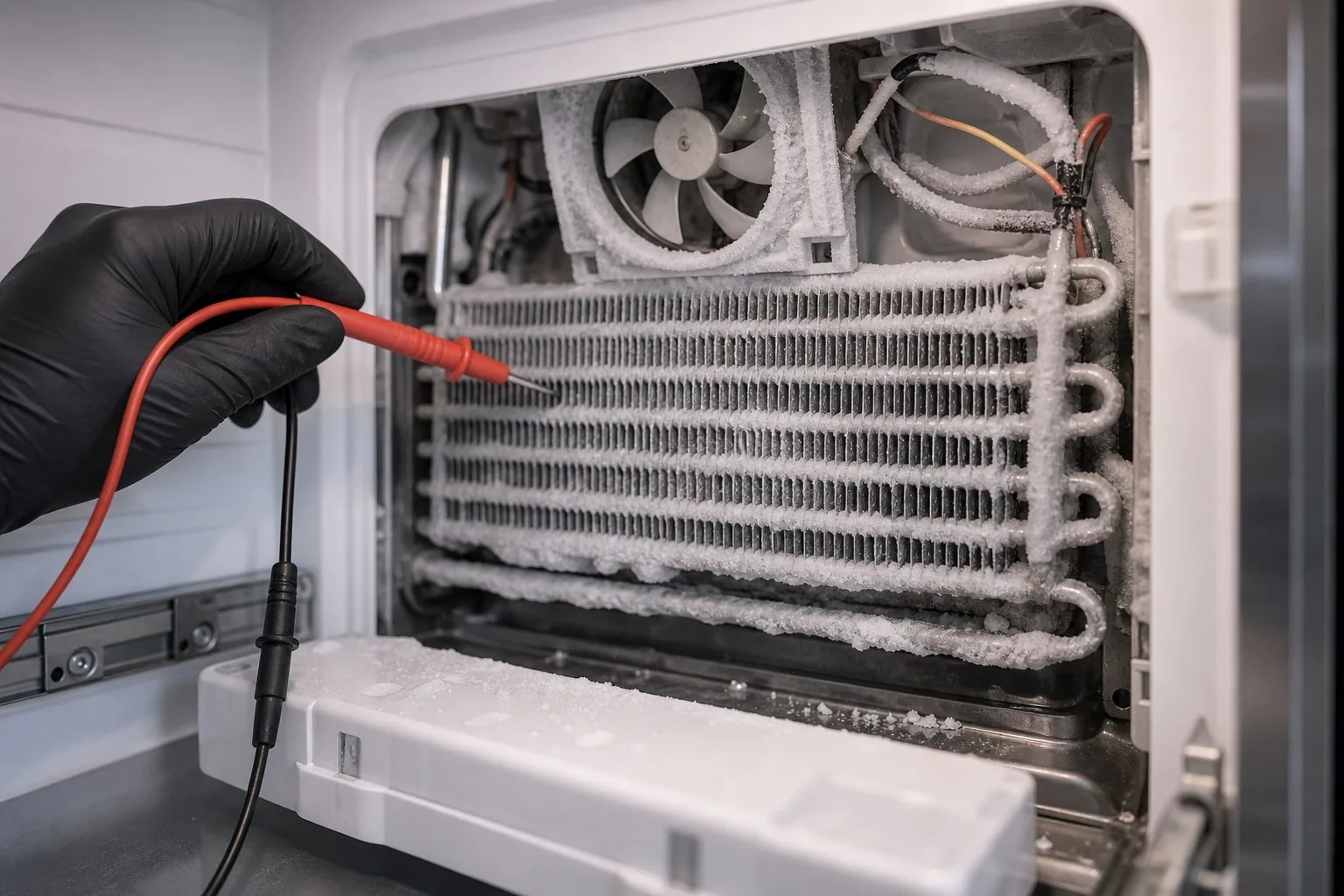
Some frost is part of how a freezer works. A thin, even haze near the air inlet appears between defrost cycles and disappears on the next one. The trouble starts when frost stops behaving like that: a thick slab grows on the back wall behind the drawers, ice creeps up the side walls, drawers freeze shut to their runners, or frost you cleared last week is back already. That pattern means the defrost chain has broken somewhere, and no amount of manual defrosting will hold until the cause is fixed.
The defrost chain, link by link
A Sub-Zero keeps its evaporator clear automatically, and the job passes through four links. Frost wins the moment any one of them fails:
- Defrost heater. On a timed cycle, a heater warms the coil just enough to melt accumulated frost. A burned-out heater is the most direct cause of a growing ice slab.
- Thermistor or bimetal terminator. This tells the system the coil is clear so the heater shuts off — and, drifted or failed, it can either cut the cycle short or skip it.
- Control. The board or timer that schedules defrost. When it stops calling for the cycle, frost simply accumulates.
- Defrost drain. The melt water has to leave. A drain that is frozen or, around here, scaled shut by hard water backs the water up where it refreezes — so the ice returns within days even after a full manual defrost.
Layered on top of all four is the door and drawer seal. A hardened or torn gasket lets warm, humid room air into the cabinet, and that moisture lands on the coldest surface and freezes. It is why frost buildup and a failing seal so often arrive together — our door gasket and seal page covers the seal side in depth.
Reading the frost
| What you see | Most likely link | What we do |
|---|---|---|
| Slab on the back wall, grows weekly | Defrost heater or terminator | Read the frost pattern, replace the failed OEM part |
| Ice returns days after a manual defrost | Clogged or frozen defrost drain | Clear and treat the drain line |
| Frost or condensation at the door edge | Worn door or drawer gasket | Dollar-bill test, replace the seal |
| Drawers frozen to the runners | Frost plus a leaking drawer seal | Thaw, clear the runner, replace the gasket |
| Warming alongside the frost | Defrost fault starving the cabinet | See our freezer not freezing page |
If you’d rather work through the whole symptom set first, the Sub-Zero troubleshooting guide lays the steps out in order, and the maintenance guide covers the seal and drain care that prevents most of this.
The local humidity and hard-water angle
San Ramon’s climate cuts both ways on frost. The dry inland summers aren’t the problem — the damp, foggy stretches are. When marine air pushes in and indoor humidity climbs, a Sub-Zero with a tired gasket pulls that extra moisture straight onto the coil, and you see frost build faster than it does in dry weather. Tall built-in columns are especially prone because the gasket runs a long vertical seam where any gap invites condensation. Then there’s the water: much of east San Ramon — Dougherty Valley, Windemere and the newer Gale Ranch streets — runs hard, and that mineral content scales the defrost drain until the melt can’t clear. The result is the classic Tri-Valley pattern of ice that comes back no matter how often you defrost. We carry genuine OEM heaters, terminators, controls and gaskets matched to your rating plate, clear and treat the drain, and work by appointment with white-glove access for gated and hillside estates. Most defrost repairs fall in the mid band on our San Ramon repair cost page, and the flat $89 service call is waived with any repair.
How to clear Sub-Zero frost and check the drain
- Empty and power downMove the contents to coolers and switch the unit off so the frost can melt fully — a half-defrost leaves a hidden core of ice that grows back fast.
- Let it fully defrostGive it several hours with the door open and towels down. Never chip at the frost with a tool; you can puncture the evaporator and turn a small repair into a sealed-system job.
- Clear the defrost drainFind the drain opening at the base of the freezer compartment and flush it with warm water. If it won't drain, the line is likely frozen or scaled and needs a technician.
- Check the seal, then restart and watchRun the dollar-bill test on the gasket, restart, and watch for a few days. If frost returns quickly, the defrost components or drain are the cause — book a diagnostic.
Frequently asked questions
Why does frost keep coming back in my Sub-Zero freezer?
Because the automatic defrost cycle isn't clearing the coil anymore. A failed defrost heater, a drifted thermistor or bimetal terminator, or a bad control means the frost never melts off on schedule and builds into a slab. If the defrost drain is also clogged, even a manual defrost only helps for a few days before the melt refreezes and the ice returns.
Why are my freezer drawers frozen shut?
Two things usually combine: a defrost fault leaving extra frost in the cabinet, and a drawer gasket that no longer seals, so humid air condenses and freezes along the runner and the drawer lip. The ice then welds the drawer to its track. Clearing the ice helps short-term, but the gasket and the defrost cause both need attention.
Is frost on the back wall normal?
A light, even haze near the air vents is normal and clears on the next defrost. What is not normal is a thick white or clear slab on the back wall behind the drawers, ice that grows day to day, or frost that returns within a week of you clearing it. That pattern is a defrost-system or drain failure, not ordinary operation.
Can a bad door seal cause frost buildup?
Yes — it is one of the most common feeders. A hardened or torn gasket lets warm, moist room air leak into the cabinet, where it condenses on the coldest surface and freezes. You'll often see condensation or frost right at the door edge first. The dollar-bill test on the gasket is a quick way to find a seal that has given up.
Does the Bay Area climate make freezer frost worse here?
It plays a role. Damp, foggy stretches push indoor humidity up, and on a Sub-Zero with a tired gasket that extra moisture shows up as faster frost on the coil. Hard water across Dougherty Valley and Windemere also scales the defrost drain, so the melt backs up and refreezes — a combination we see often in Tri-Valley kitchens.
What clients say
4.9 · 327 reviews
Frost kept rebuilding on the back wall no matter how often I defrosted it. The tech found the defrost drain scaled nearly shut on our hard water, so the melt was refreezing every cycle. He cleared and treated the drain, replaced a weak terminator, and a month on the freezer is bone-dry. Genuinely explained the why.
Our freezer drawers were frozen solid to the runners. He thawed it properly, then showed me the drawer gasket had hardened and was letting damp air in along the edge. New OEM seal, drain flushed, and he checked the defrost heater while he was in there. Drawers glide again and no more ice welding them shut.
Condensation turning to frost right at the door of our built-in column. After a foggy damp week it got bad. The tech traced it to a tired gasket pulling in humid air, replaced it, and confirmed the defrost cycle was working. Careful around the custom panel, clear flat quote, and the door edge is dry now.