
Quick answers
- Why is my Sub-Zero suddenly louder than it used to be?
- Almost always because a fan is moving against more resistance. The condenser fan behind the upper grille spins faster and longer when its coil is choked with dust or wildfire ash, which is the most common reason a built-in gets noticeably louder over a hot San Ramon week. Pull the grille and look at the coil before assuming the worst.
- What does a Sub-Zero compressor sound like when it's failing?
- A healthy compressor is a low, steady hum from the floor at the back. A failing one runs louder and more labored, may clatter or rattle on start-up, or buzz and click as it tries and fails to start. That deep mechanical noise is the one to act on quickly — keep the doors shut and book a sealed-system diagnostic.
- My Sub-Zero buzzes and then knocks about once an hour — is that normal?
- Usually yes. That pattern is the ice-maker fill cycle: the water inlet valve buzzes as it opens, water runs, then the mold thunks as it harvests. It becomes a real problem when the valve chatters loudly or the unit hammers, which hard water around Dougherty Valley can cause as scale builds on the valve.
- Why is the noise coming from inside the freezer?
- That is the evaporator fan, the one that pushes cold air through the cabinet. A worn bearing makes it chirp or squeal, and a frost build-up that lets the blade clip ice makes a ticking or grinding sound. Both need a technician, because reaching that fan means pulling the freezer back panel.
Match the sound to the part
A Sub-Zero is a quiet machine by design, so a new noise is information — it tells you which moving component is working harder than it should. There are only a handful of things in a built-in that can make sound, and each one has a signature. Before you assume the worst, separate where the noise lives: behind the upper grille, down at floor level, or inside the cabinet.
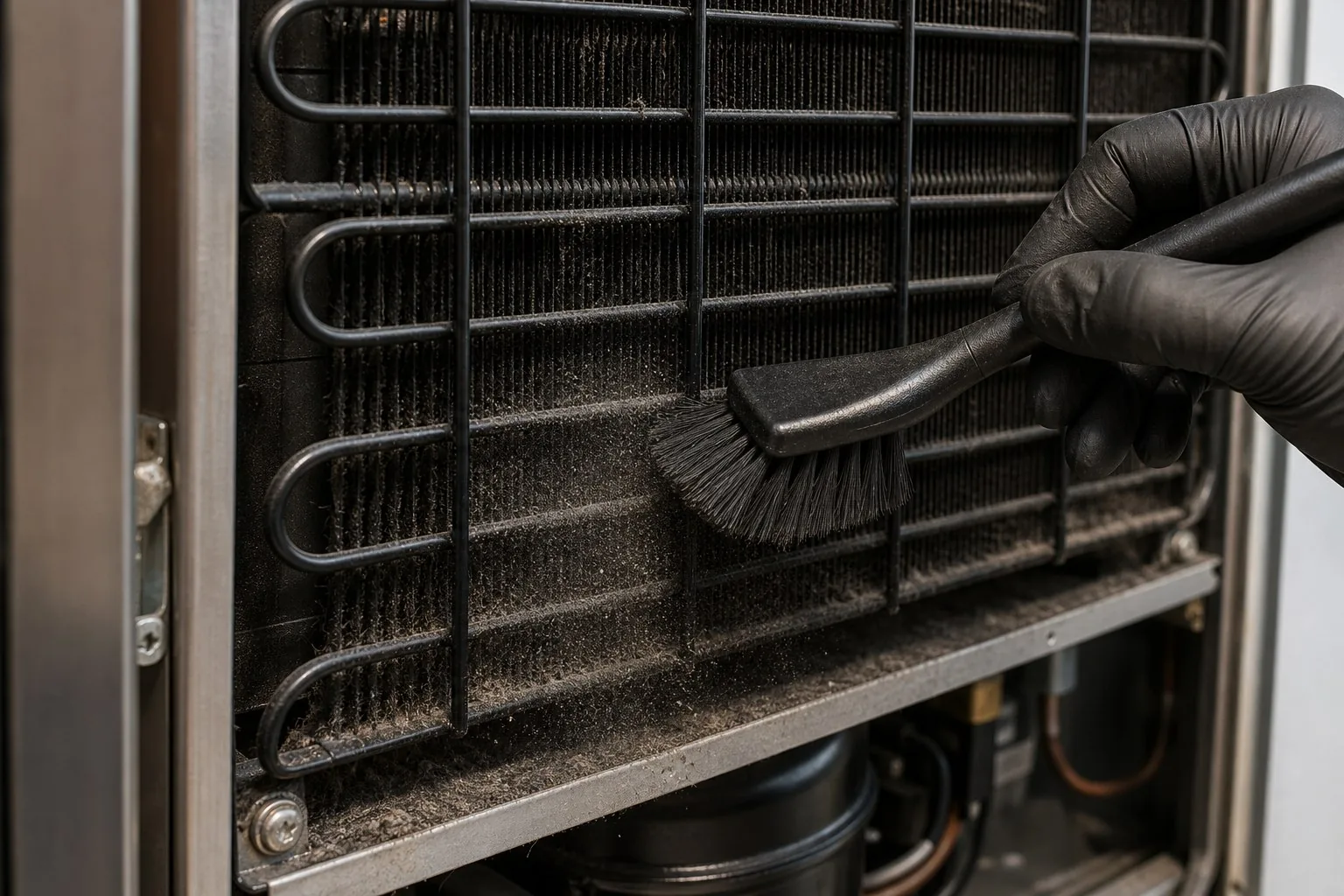
- A whir, hum or light rattle from the upper grille is the condenser fan. It runs faster and longer when the coil it cools is loaded with dust, pet hair or wildfire ash, so this is the noise that creeps up over a hot week and the easiest one to fix yourself.
- A deep, steady hum from the floor at the back is the compressor. Steady is normal. Labored, clattering, or a buzz-and-click that never settles into a run is not.
- A chirp, squeal, tick or grind from inside the freezer is the evaporator fan — the fan that actually moves cold air through both compartments. A worn bearing squeals; ice touching the blade ticks or grinds.
- A short electrical buzz followed by a thunk, roughly hourly, is the ice maker filling and harvesting. Normal in rhythm; a problem when it chatters or hammers.
- A faint sizzle or trickle after the unit cycles off is defrost water hitting the drain pan, and is completely normal.
Where each Sub-Zero noise comes from
| What you hear | Where it is | Likely cause | What we do |
|---|---|---|---|
| Loud whir, louder in heat | Upper grille | Condenser fan working a dust- or ash-choked coil | Deep-clean the coil, test the fan motor |
| Deep labored hum, clatter on start | Floor, rear | Tired compressor or start components | Sealed-system diagnostic, OEM start parts or compressor |
| Chirp or squeal, constant | Inside freezer | Worn evaporator-fan bearing | Replace the evaporator fan motor |
| Tick or grind only when running | Inside freezer | Frost letting the fan blade clip ice | Clear the frost, correct the defrost fault, check the fan |
| Buzz then knock, about hourly | Top of freezer | Ice-maker fill valve and harvest | Confirm normal, or replace a scaled valve |
| Rattle or vibration, intermittent | Anywhere on cabinet | Tubing or drain pan touching the case | Re-seat the line, secure the pan |
If the sound arrives with a warm compartment, work through our Sub-Zero not cooling page in parallel — a straining condenser fan and a warming fridge often share the same choked coil.
Why San Ramon kitchens hear it more
Two local things make Sub-Zero noise more common and more noticeable here than the design assumes. The first is heat and grit. San Ramon and the surrounding Tri-Valley run a genuinely inland summer — kitchens sit in the 90–100°F range, and the dry Diablo winds that sweep down off Mount Diablo carry fine dust and, in fire season, ash straight into the upper grille. A coil under that load forces the condenser fan to spin faster and longer, and that is the single most common reason a homeowner here says their built-in “suddenly got loud.” Our condenser cleaning and wildfire-season condenser care pages cover that maintenance in detail.
The second is water. Much of east San Ramon — Dougherty Valley, Windemere, Gale Ranch — runs on hard water that scales up the ice-maker inlet valve over time. A scaled valve buzzes and chatters as it opens, turning the normal hourly fill into an audible knock you notice from across an open-plan kitchen. That same open layout, common in newer Gale Ranch and Bishop Ranch–adjacent homes, is part of why noise that an older closed kitchen would have hidden now carries into the living space.
When a noise means stop using it
Most refrigerator noise is a fan asking for maintenance, and you can book at your convenience. A few sounds mean act now. A grinding evaporator fan can shred a blade and dump ice debris into the cooling path. A compressor that clatters, buzzes-and-clicks without starting, or runs visibly louder than it used to is heading toward a sealed-system repair — keep both doors closed and book a diagnostic before it fails entirely. Any electrical burning smell with a noise means kill the power at the breaker and call. For what those repairs typically run, see our San Ramon repair cost page and the broader Sub-Zero repair in San Ramon overview. A flat $89 service call applies and is waived with any repair, and we carry genuine OEM fan motors, valves and start components matched to the model on your rating plate so most noise faults are fixed in a single visit.
How to locate a Sub-Zero noise before you call
- Stand at the front and listenA whir or rattle that seems to come from the upper grille area is the condenser fan; a hum from the floor is the compressor; a sound from inside the cabinet is the evaporator fan or ice maker.
- Pull the upper grille and inspect the coilIf the condenser fan is loud, the coil behind it is usually packed with dust or ash. Brush and vacuum it front to back without bending the fins, then listen again.
- Open the freezer and pause the ice makerLift the ice-maker arm or switch it off for a cycle. If a periodic buzz-and-knock stops, it was the fill valve, not a mechanical fault.
- Note when it happens and bookWrite down whether the noise is constant, only when cooling, or only on the hour. That timing lets the technician load the right part for one trip.
Frequently asked questions
Why is my Sub-Zero suddenly louder than it used to be?
Almost always because a fan is moving against more resistance. The condenser fan behind the upper grille spins faster and longer when its coil is choked with dust or wildfire ash, which is the most common reason a built-in gets noticeably louder over a hot San Ramon week. Pull the grille and look at the coil before assuming the worst.
What does a Sub-Zero compressor sound like when it's failing?
A healthy compressor is a low, steady hum from the floor at the back. A failing one runs louder and more labored, may clatter or rattle on start-up, or buzz and click as it tries and fails to start. That deep mechanical noise is the one to act on quickly — keep the doors shut and book a sealed-system diagnostic.
My Sub-Zero buzzes and then knocks about once an hour — is that normal?
Usually yes. That pattern is the ice-maker fill cycle: the water inlet valve buzzes as it opens, water runs, then the mold thunks as it harvests. It becomes a real problem when the valve chatters loudly or the unit hammers, which hard water around Dougherty Valley can cause as scale builds on the valve.
Why is the noise coming from inside the freezer?
That is the evaporator fan, the one that pushes cold air through the cabinet. A worn bearing makes it chirp or squeal, and a frost build-up that lets the blade clip ice makes a ticking or grinding sound. Both need a technician, because reaching that fan means pulling the freezer back panel.
Is it safe to keep running a noisy Sub-Zero?
A condenser-fan whir or an ice-maker buzz is fine to run while you book. A grinding evaporator fan, a clattering compressor, or any burning smell is not — those can turn a small repair into a sealed-system job, so shut the ice maker or the unit down and call.
What clients say
4.9 · 327 reviews
Our built-in got embarrassingly loud during that late-August heat — you could hear it from the Gale Ranch great room. The tech tracked the whir to the condenser fan straining against a coil packed with fine grit off the Diablo winds, cleaned it, and the fan quieted down within the hour. No part needed, just an honest read.
A chattering buzz every hour was driving us up the wall. He showed me it was the ice-maker fill valve hammering on our hard water, replaced the valve with an OEM part, and added a note about descaling. The hourly racket is gone and the cubes are clear again. Clear quote, no upsell.
Grinding from inside the freezer turned out to be the evaporator fan blade clipping a slab of frost from a lazy defrost. He pulled the back panel, cleared the ice, and replaced the tired fan motor. Explained why the frost formed in the first place. Quiet ever since, and he worked carefully around the cabinetry.