
Wolf vs Viking vs Thermador: how do the pro ranges actually differ?
They differ less in how they cook than in how they break. A Wolf, Viking and Thermador range can sit in the same Tri-Valley kitchen looking like rivals, yet each one routes ignition, heat and electronics through its own hardware — and that hardware decides what a repair costs and how long it takes. The useful question isn’t “which brand is best,” but “which part is failing, and on which design.” This guide compares the three on the faults we actually see across San Ramon, Danville and the wider Bay Area, brand-true to each maker’s own engineering.
The clearest dividing line is electronics. Viking’s flagship pro range keeps the oven mechanical — a glow-bar igniter, no bake element — so its repairs stay simple and its parts stay cheap and available. Wolf raises the stakes with dual-fuel, pairing gas burners with an electric oven that cycles bake and broil elements against an RTD sensor. Thermador goes furthest, offering Freedom Induction ranges whose inverter power boards are the single costliest part we quote across all three. Match the brand to your cooking, then know the repair profile that rides along with it.
Which pro range is easiest to repair?
For pure repairability, an all-gas Viking usually wins, because its faults are mechanical and its parts widely stocked. Wolf follows close behind on the cooktop thanks to a shared, well-documented spark module, while its dual-fuel oven adds an electric element and sensor to the mix. Thermador’s gas ranges repair much like the others, but its induction models sit at the hard end — a failed inverter board is the dearest fix of the three. The table below lines up the three brands on the parts that fail most.
| Failure point | Wolf | Viking | Thermador |
|---|---|---|---|
| Cooktop ignition | Sealed burners, shared spark module behind red knobs; one-dead-burner faults are local | Larger pro-burner ports, spark system; ports clog faster, cleaning fixes many calls | Star Burner geometry, spark module; even flame but debris hides in star channels |
| Oven heating | Dual-fuel: electric bake/broil elements + RTD sensor; gas: glow-bar igniter | Gas oven uses a glow-bar igniter, no bake element — simplest of the three | Convection elements or gas glow-bar by line; F-style fault codes on the control |
| Induction | Available, but flagship is gas/dual-fuel | Limited; gas remains the core | Freedom Induction inverter power boards — costliest single part across all brands |
| Parts cost & supply | Mid: igniters, elements, sensors moderate and stocked | Lowest: mechanical gas parts cheap and widely available | Highest when induction is involved; gas parts comparable to the others |
| Typical repair band | $200-$700 non-electronic; dual-fuel control higher | $200-$700, often at the lower end | $200-$700 gas; induction board pushes well past |
For the brand-specific deep dives, see our Wolf range repair, Viking repair and Thermador repair hubs — each covers that maker’s full lineup and OEM parts.
Why brand-specific knowledge changes the bill
A clicking Wolf burner, a yellow Viking flame and a dropped Thermador induction zone look like three versions of the same complaint, but they live on three different machines. We measure igniter draw, element resistance, sensor curve and board output against each maker’s spec before naming a part, so a simple Viking glow-bar swap never gets quoted as a control-board job, and a genuine Thermador inverter board only gets ordered once the board itself tests bad. That same discipline drives our broader professional range repair work and our honest repair vs replace guidance — a 15-year pro range framed into custom cabinetry is almost always worth fixing.
How Bay Area kitchens push these ranges differently
Local conditions wear each design in its own way. Inland San Ramon, Danville and the Tri-Valley run 90-100°F summer kitchens that heat-soak Wolf spark modules, Thermador induction boards and every RTD sensor until readings drift. Hard water across the region bakes mineral scale onto Viking’s broad burner ports and into Thermador’s star channels, where boilovers collect. Wildfire-season ash settles into burner ports and convection intakes within weeks on all three. Closer to the coast and fog line, salt air corrodes burner caps and igniter terminals — which is why clicking-but-no-light calls cluster on Peninsula and Marin units. We clean and reseat to each maker’s alignment markings, fit genuine OEM parts matched to the rating plate, and work gated, hillside and white-glove estate access by appointment. A flat $89 service call applies and is waived with any repair, open 24/7 across the Bay Area.
Quick answers
- Wolf vs Viking vs Thermador range — which is best to own and repair?
- No single winner. Wolf offers the most consistent dual-fuel ignition and clear red-knob diagnostics. Viking gas ovens are the simplest mechanically, so parts are cheap. Thermador's Star Burner and induction cook beautifully but its induction boards are the priciest part. Pick by cooking style, then budget for the matching repair profile.
- Which pro range is easiest to repair?
- For pure repairability, an all-gas Viking is usually easiest: glow-bar oven igniters and spark cooktops are mechanical, cheap and widely stocked. Wolf is close behind on the cooktop thanks to its shared spark module. Thermador induction is hardest — a failed inverter board is the costliest fix among the three.
- How do igniter failures differ between Wolf, Viking and Thermador?
- Wolf and Thermador spark cooktops fire from a module behind the controls, so one dead burner is local and all dead points at the module. Viking pro burners use a similar spark system but larger ports that clog faster. Gas ovens on all three use a glow-bar igniter that weakens until it can't open the safety valve.
- Does Thermador induction make repairs more expensive than Wolf or Viking?
- Often, yes. Freedom Induction ranges replace burners with coils driven by inverter power boards, and that board is the single costliest part across the three brands. Wolf and Viking induction exists too, but their flagship gas and dual-fuel ranges keep most repairs in the cheaper mechanical band.
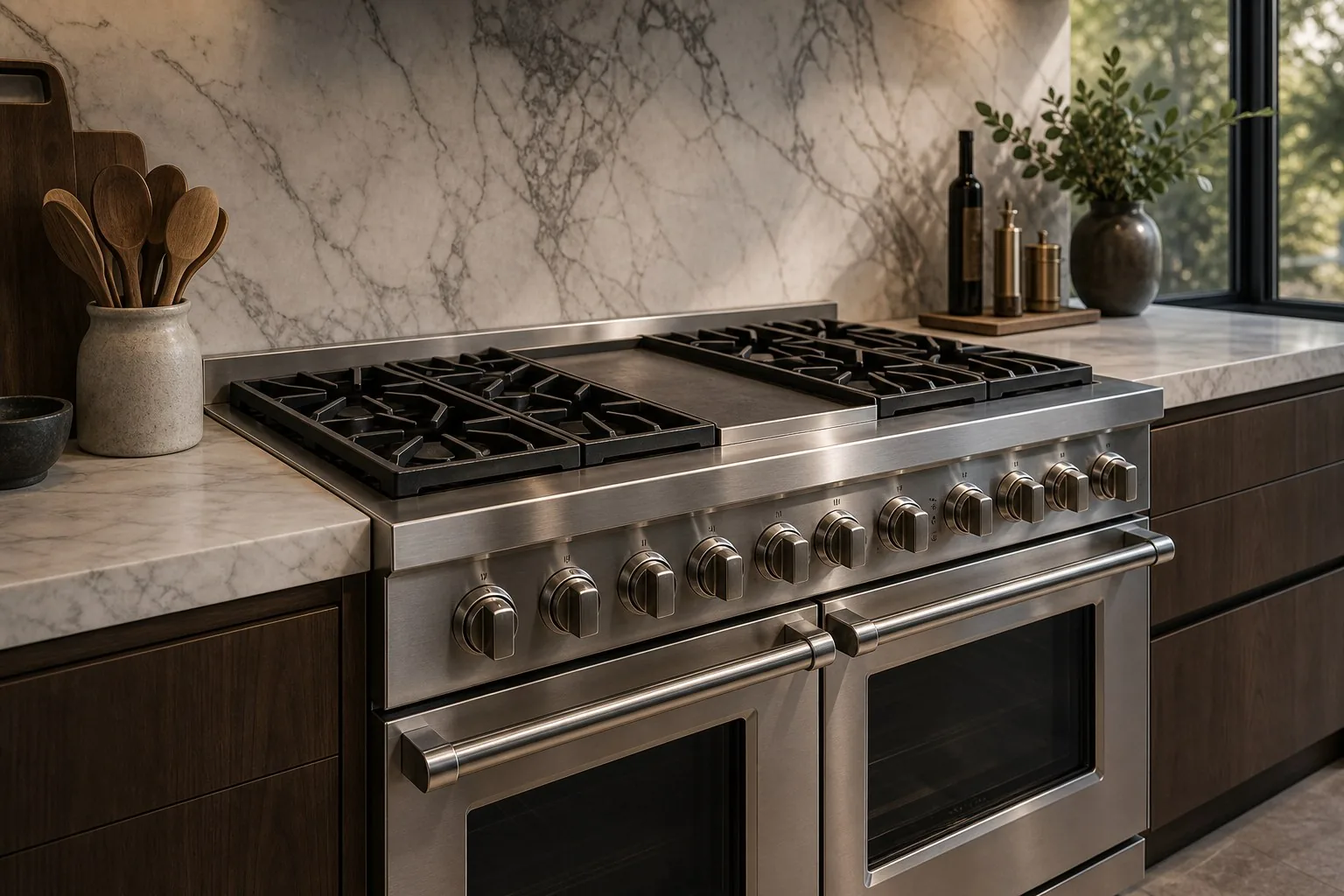
Cooktop ignition compared
Three burners, three ways a flame fails to catch
Wolf fires sealed burners from one shared spark module behind its red knobs, so a single dead burner is a local igniter or cap while all dead points upstream. Viking's larger pro-burner ports throw more heat but clog faster on boilovers, so cleaning and reseating fixes more Viking calls than parts do. Thermador's Star Burner spreads flame along a star-shaped port pattern that lights evenly but hides debris in the channels — telling the geometry apart up front tells us where the fault has to be.
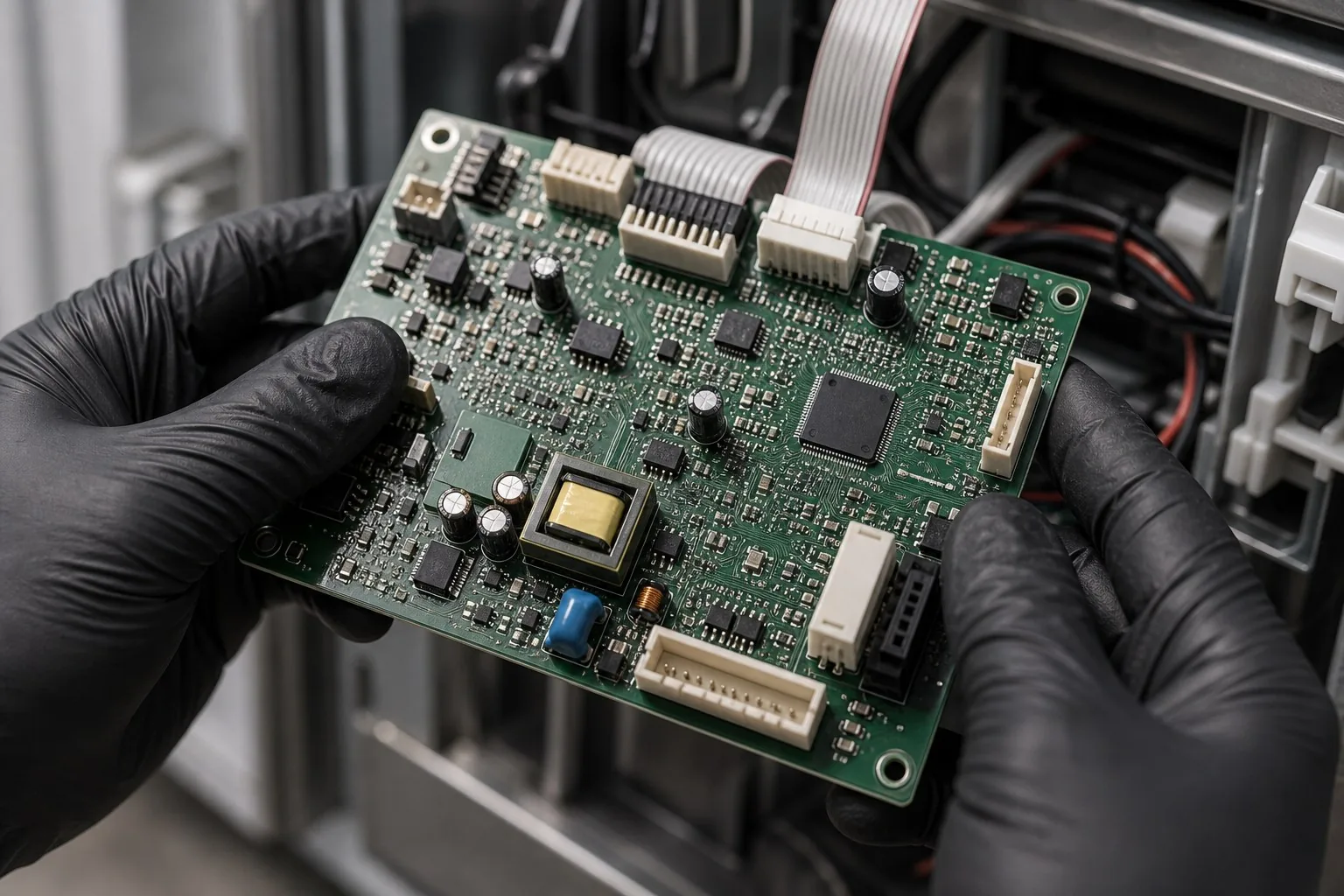
Where the electronics live
Dual-fuel control, RTD sensors, and induction boards
On the oven side the brands diverge sharply. Wolf dual-fuel cycles electric bake and broil elements against an RTD sensor through a control that fails far less often than the parts it drives. Viking's gas oven skips elements entirely, leaning on a glow-bar igniter — the simplest, cheapest oven of the three. Thermador adds the wild card: Freedom Induction ranges run inverter power boards whose replacement is the dearest single part we quote across all three makes.
Tell which pro range you own before you book
- Read the rating plateFind the model and serial plate (often behind the kick panel or on the oven frame) so the diagnosis matches your exact Wolf, Viking or Thermador model.
- Name the cooktop typeSealed burners with red knobs are Wolf; broad open or sealed pro burners are Viking; a star-shaped burner port is Thermador's Star Burner; a flat glass surface is induction.
- Name the oven typeAn electric convection oven under gas burners is dual-fuel; a gas oven uses a glow-bar igniter, not an element. This decides whether a no-heat fault is electrical or mechanical.
- Note which half failedA dead burner is a cooktop fault; a cold oven is separate. On dual-fuel and induction the two systems are unrelated, so describe each precisely.
- Book the diagnosticShare the model and both symptoms so the right OEM igniter, element, sensor or board rides in the van for a single-trip repair.
Frequently asked questions
Wolf vs Viking vs Thermador range — which is best to own and repair?
No single winner. Wolf offers the most consistent dual-fuel ignition and clear red-knob diagnostics. Viking gas ovens are the simplest mechanically, so parts are cheap. Thermador's Star Burner and induction cook beautifully but its induction boards are the priciest part. Pick by cooking style, then budget for the matching repair profile.
Which pro range is easiest to repair?
For pure repairability, an all-gas Viking is usually easiest: glow-bar oven igniters and spark cooktops are mechanical, cheap and widely stocked. Wolf is close behind on the cooktop thanks to its shared spark module. Thermador induction is hardest — a failed inverter board is the costliest fix among the three.
How do igniter failures differ between Wolf, Viking and Thermador?
Wolf and Thermador spark cooktops fire from a module behind the controls, so one dead burner is local and all dead points at the module. Viking pro burners use a similar spark system but larger ports that clog faster. Gas ovens on all three use a glow-bar igniter that weakens until it can't open the safety valve.
Does Thermador induction make repairs more expensive than Wolf or Viking?
Often, yes. Freedom Induction ranges replace burners with coils driven by inverter power boards, and that board is the single costliest part across the three brands. Wolf and Viking induction exists too, but their flagship gas and dual-fuel ranges keep most repairs in the cheaper mechanical band.
Are oven elements interchangeable between these brands?
No. Bake and broil elements, RTD sensors and control boards are brand-specific and often model-specific, matched to the rating plate. A Wolf dual-fuel element won't fit a Thermador, and Viking's gas oven uses an igniter rather than an element at all. We carry the genuine OEM part for the exact model.
Should I repair or replace a 15-year-old pro range?
Repair, in almost every case. A Wolf, Viking or Thermador range framed into custom cabinetry costs $8,000-$15,000 to replace, while most faults are a single igniter, element, sensor or burner part. We only suggest replacement when several major components — or an induction power board plus controls — have failed together.
What clients say
5 · 699 reviews
I was deciding whether to fix our Viking range or upgrade to a Wolf. The technician walked me through how each brand fails before touching anything — Viking's glow-bar oven was a cheap igniter swap, not the rebuild a dispatcher had quoted. Honest comparison saved us thousands and the oven heats evenly again.
Our Thermador Freedom Induction range had two zones drop out. He explained why induction repairs differ from our old Wolf gas range — it was an inverter power board, the priciest part he'd quote. He confirmed it against board output rather than guessing, sourced the genuine OEM board, and both zones run full power now.
Mixed kitchen: a Wolf dual-fuel range and a Thermador Star Burner cooktop. One Wolf burner clicked without catching while a Thermador star port ran yellow. He treated them as different geometries — reseated the Wolf cap, cleared the clogged star channels — instead of selling parts. Clear written quote, no upsell.